Coccyx Pain
Coccyx Pain and Sitting: How Long Is Too Long?
By Coccyx Relief Editorial Team · Updated 2026-03-01
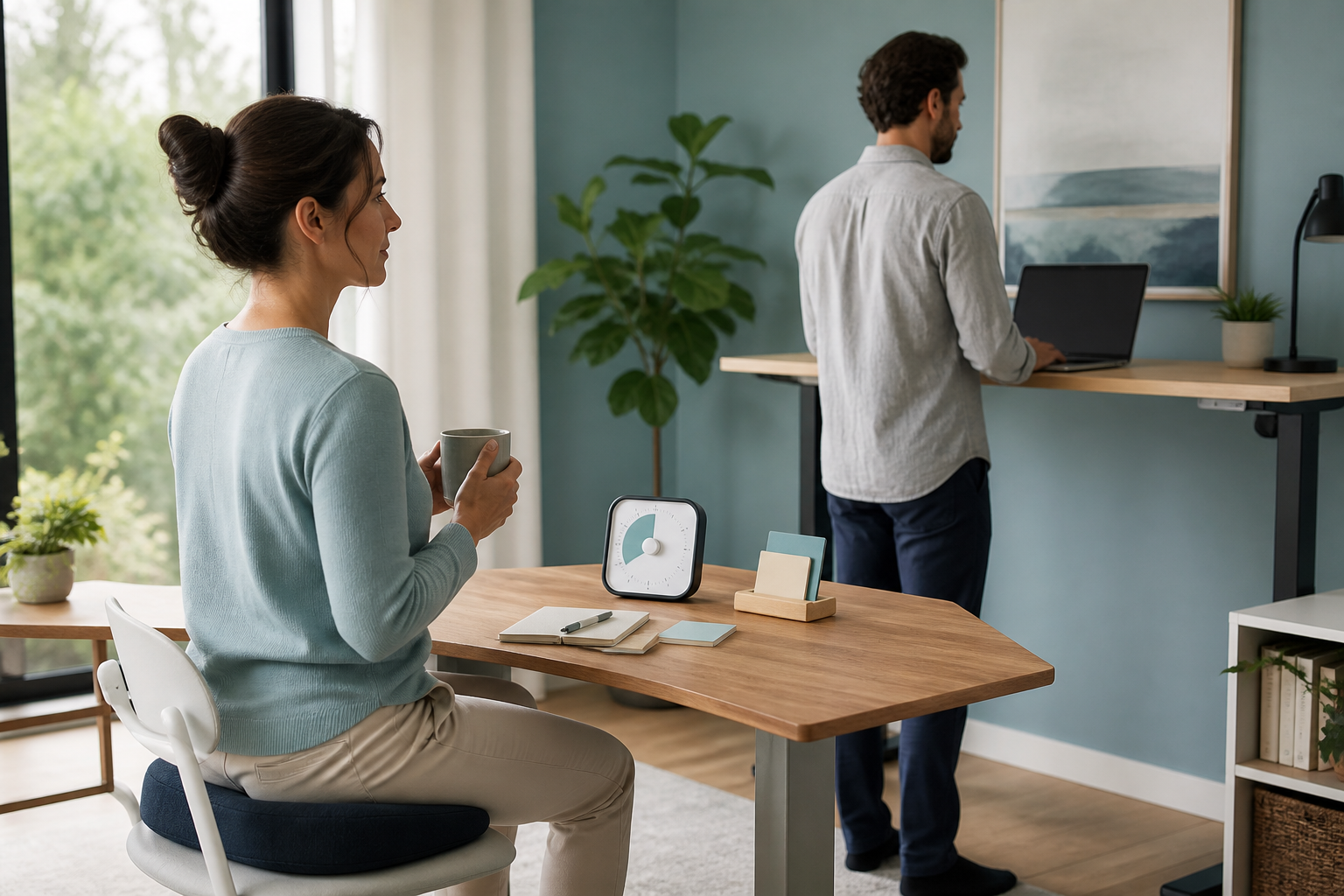
Research shows coccyx pressure increases progressively with sitting duration, with significant tissue stress beginning after 20–30 minutes on a hard surface without movement. For most people with coccydynia, the safe sitting limit before pain escalates is 20–45 minutes — but this can be significantly extended with the right setup.
This guide covers the evidence, warning signs, and practical strategies to sit longer without pain.
The Coccyx Relief System: Everything You Need in One Place
Exercises, ergonomic setups, stretches, and a complete daily program. 30+ pages, instant download.
Get My Coccyx Relief SystemInstant download • 30-day money-back guarantee
Table of Contents
- What Happens to Your Coccyx When You Sit
- Time Limits: The Evidence
- Warning Signs You Have Sat Too Long
- Factors That Affect Your Safe Sitting Limit
- 5 Strategies to Sit Longer Without Pain
- The Right Way to Sit with Coccyx Pain
- Standing Desks and Coccyx Pain
- Frequently Asked Questions
What Happens to Your Coccyx When You Sit
When you sit, your body weight is distributed across:
- The ischial tuberosities (sitting bones) — bear the majority of your weight
- The thighs
- The coccyx — bears a variable but significant portion, especially on hard surfaces or in poor posture
The Posterior Tilt Problem
The most common sitting posture — slightly slumped, pelvis tilted backward — shifts weight away from the ischial tuberosities and directly onto the coccyx. This is called posterior pelvic tilt, and it is the root cause of most sitting-related coccyx pain.
A study in Ergonomics found that a 10° posterior pelvic tilt increases coccygeal pressure by approximately 15% compared to neutral seating. Over 4–6 hours, this accumulates significantly.
Tissue Compression and Ischaemia
Evidence note: This comparison uses manufacturer specifications, published research, and independently reported owner feedback. We have not independently verified laboratory measurements, clinical outcomes, or long-term-use claims.
Time Limits: The Evidence
For people without coccyx pain
Healthy individuals without tailbone pain typically begin to experience discomfort from sitting around 90 minutes on a moderately comfortable chair. The body naturally prompts micro-movements (fidgeting) every 8–12 minutes to redistribute pressure.
For people with coccyx pain
With active coccydynia:
- Hard surface (wooden chair, floor): Pain onset in 10–20 minutes for many people
- Standard office chair without cushion: 20–45 minutes before significant escalation
- Office chair with a quality coccyx cushion: 60–120 minutes before discomfort escalates
- Properly adjusted ergonomic chair + coccyx cushion: 2–3 hours before rest is needed
These are general guidelines. Your specific limit depends on the severity of your condition, the chair type, and whether you are doing anything to manage position during sitting.
The pain accumulation effect
Coccyx pain does not simply switch on at a specific time point. It accumulates gradually throughout a sitting session. The important practical implication: if you stand up and move for 5 minutes at 40 minutes, you can often sit for another 40 minutes before pain returns to the same level. This is why timed movement breaks are more effective than just having a better chair.
Warning Signs You Have Sat Too Long
These signals indicate you need to stand and move:
- Dull ache at the base of the spine — the earliest warning signal
- Fidgeting more than usual — your body is trying to redistribute pressure
- Pain that worsens with any slight movement while seated — tissue is becoming sensitised
- "Pins and needles" in the buttocks — early circulation compromise
- Sharp pain when shifting position in the chair — the coccyx is now significantly loaded
Do not wait for the sharp pain. By the time you feel significant pain, tissue irritation has accumulated significantly and recovery time is much longer.
Prefer a Structured Recovery Plan? Review the System
Use a step-by-step plan with exercises, setup guidance, and clear pacing prompts.
Get My Coccyx Relief SystemInstant download • 30-day money-back guarantee
Factors That Affect Your Safe Sitting Limit
| Factor | Reduces Safe Sitting Time | Extends Safe Sitting Time |
|---|---|---|
| Chair type | Hard, flat seats | Ergonomic chair with seat tilt |
| Cushion | No cushion | Quality coccyx cushion (deep cutout) |
| Posture | Posterior pelvic tilt (slumped) | Neutral pelvis, slight anterior tilt |
| Pain severity | Active/acute coccyx pain | Mild or chronic/managed pain |
| Body weight | Very low or very high BMI | Healthy BMI range |
| Activity breaks | Static sitting, no movement | Regular breaks every 30–45 min |
| Fatigue | End of day, tired posture | Fresh, early in the day |
5 Strategies to Sit Longer Without Pain
Strategy 1: Use a Coccyx Cushion (Most Effective)
A cushion with a deep U-shaped rear cutout eliminates direct contact between the coccyx and the seat surface. This single intervention typically extends comfortable sitting time by 60–120% for people with active coccydynia.
What to look for:
- U-shaped cutout at least 3 inches deep
- High-density memory foam (45+ kg/m³) that does not bottom out
- Minimum 3 inches thick
Strategy 2: Set a 45-Minute Timer
The most evidence-based intervention for prolonged sitting is simply not sitting for too long without a break. Set a timer — phone alarm, desk reminder, or a wearable. When it goes off: stand, walk briefly, do a few stretches, then sit back down.
The 45-minute interval is the sweet spot for most people with coccyx pain: long enough to complete meaningful work, short enough that pressure accumulation does not reach pain-triggering levels.
Strategy 3: Optimise Your Sitting Posture
The most protective sitting posture for coccyx pain:
- Pelvis neutral or slightly forward-tilted (not slumped backward)
- Back in full contact with the chair backrest
- Feet flat on the floor, knees at ~90°
- Weight evenly distributed on both sitting bones
- Avoid crossing legs — this creates asymmetrical pelvic loading
Strategy 4: Adjust Your Chair
Chair adjustments that reduce coccyx pressure:
- Lower seat height until feet are flat on the floor without pressure behind the knees
- Enable forward seat tilt if your chair has it — this shifts weight onto the thighs
- Adjust seat depth so there are 2–3 finger-widths between the seat edge and behind your knees
- Set lumbar support at the curve of your lower back, not the upper back
Strategy 5: Gentle Chair Stretches Every 20–30 Minutes
You do not always need to stand up. Mini-movements in your chair help redistribute pressure:
- Seated pelvic tilts: Rock pelvis forward and back 5–10 times
- Alternating weight shifts: Shift weight from one sitting bone to the other, hold 10 seconds each side
- Knee-to-chest (modified): Draw one knee toward your chest for 15 seconds while seated
- Seated figure-4: Cross one ankle over the opposite knee for 20 seconds
The Right Way to Sit with Coccyx Pain
Many people with coccyx pain try to alleviate it by sitting forward (perching on the edge of the seat), leaning sideways, or slouching deeply. All of these are counterproductive:
- Perching forward: Removes lumbar support and increases shear forces on the sacrococcygeal joint
- Leaning sideways: Creates asymmetrical loading that can cause secondary hip and lumbar problems
- Deep slouching: Posterior pelvic tilt — the worst position for coccyx pressure
The correct position:
- Sit fully back in the chair so your back contacts the lumbar support
- Your coccyx should hover over or gently rest on a coccyx cushion cutout — not be compressed against the chair
- Keep your thighs parallel to the floor or angled very slightly downward
Standing Desks and Coccyx Pain
A height-adjustable standing desk is one of the most practical investments for anyone with coccyx pain who works at a computer.
Benefits:
- Allows you to alternate between sitting and standing throughout the day
- Removes all sitting-related coccyx pressure during standing intervals
- Enables more flexibility in your movement schedule
Important: Standing all day is not the goal — that has its own problems. The aim is alternating between sitting and standing every 30–60 minutes.
A common schedule that works well: 45 minutes sitting → 15 minutes standing → repeat.
Frequently Asked Questions
How long should I sit if I have coccyx pain? Aim for no more than 45–60 minutes at a stretch before taking a 5-minute standing and movement break. With a quality coccyx cushion and good posture, many people can extend comfortable sitting to 90–120 minutes.
Is it better to stand all day than sit with coccyx pain? No. Alternating between sitting and standing is better than either extreme. Prolonged standing has its own issues (foot, ankle, and knee pain). Use a height-adjustable desk and alternate every 45–60 minutes.
Does sitting on a hard surface make coccyx pain worse? Yes, significantly. Hard surfaces concentrate pressure on the coccyx rather than distributing it. Always use a coccyx cushion on hard chairs (wooden chairs, bleachers, auditorium seating).
Can I ever sit normally again with coccyx pain? Most people with coccyx pain return to normal sitting ability through a combination of treatment (physiotherapy, injections if needed), ergonomic adjustments, and targeted exercise. Many people with chronic coccydynia find a coccyx cushion becomes a permanent management tool they use habitually, much like someone with back pain uses lumbar support.
Review the Coccyx Relief System
Review 30+ pages of exercises, practical methods, pacing guidance, and a structured daily plan.
Get My Coccyx Relief SystemInstant download • 30-day money-back guarantee