Coccyx Pain
Coccyx Pain vs Sciatica: How to Tell the Difference (2026)
By Coccyx Relief Editorial Team · Updated 2026-03-01
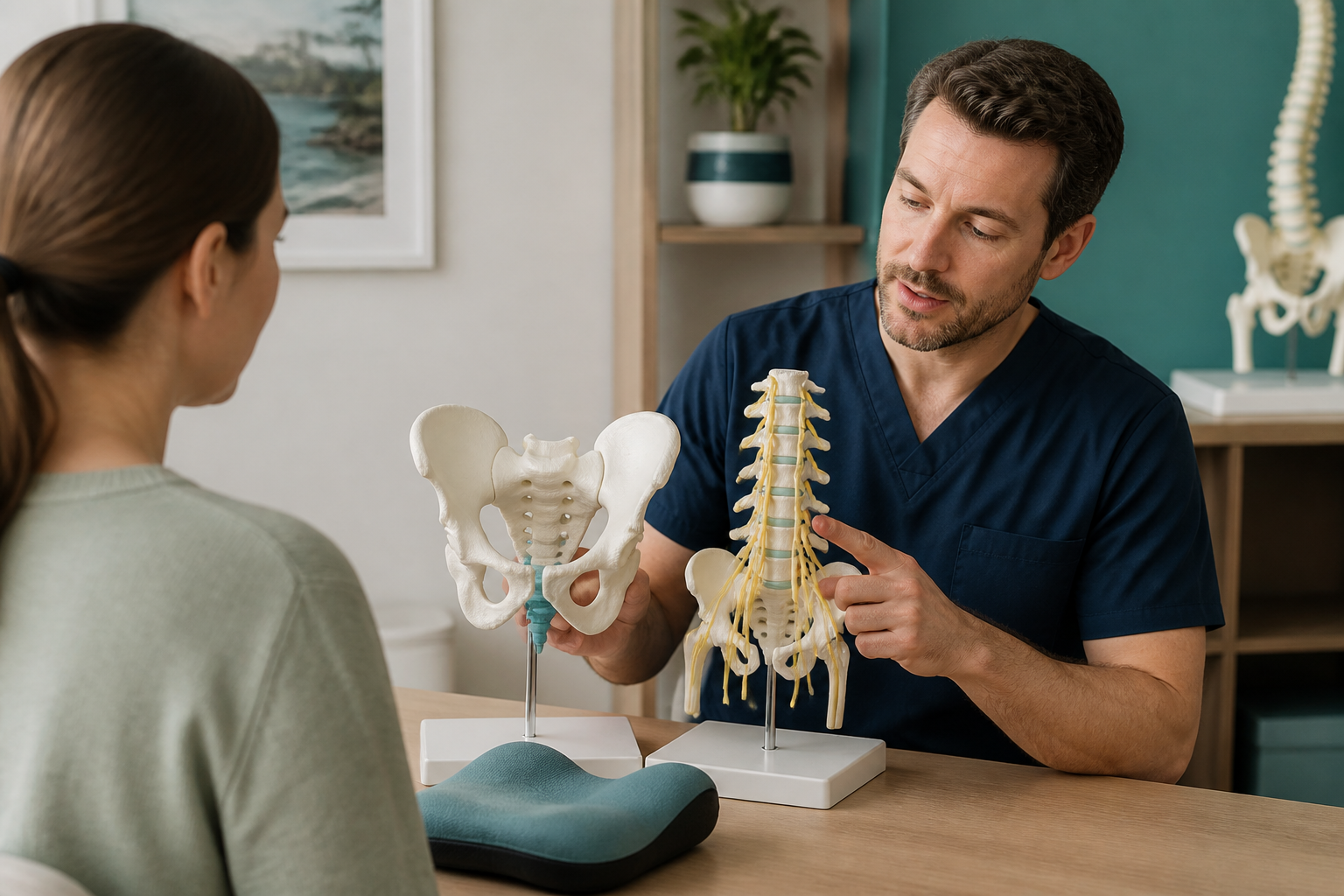
Coccyx pain (coccydynia) and sciatica are frequently confused because both cause pain in the lower back and buttock region. However, they have completely different causes, different treatment approaches, and different pain patterns. Getting the diagnosis right is essential — treating sciatica as coccyx pain (or vice versa) can delay recovery significantly.
Table of Contents
- The Core Difference
- Anatomy: What Is Actually Hurting?
- Symptoms Comparison
- Key Diagnostic Questions
- Can You Have Both?
- Diagnosis
- Treatment: How They Differ
- When to See a Doctor
- Frequently Asked Questions
The Core Difference
Coccyx pain is localised to the tailbone (the small bony protrusion at the very base of the spine). It is primarily a mechanical and soft tissue problem involving the sacrococcygeal joint, surrounding ligaments, and pelvic floor muscles.
Sciatica is pain caused by compression or irritation of the sciatic nerve, which originates from the lumbar and sacral nerve roots (L4–S3). It typically causes pain that travels down the leg.
The key question: Does your pain go down your leg?
- If yes: sciatica is likely involved
- If no, and pain is localised to the tailbone: coccydynia is more likely
Anatomy: What Is Actually Hurting?
Coccyx Pain (Coccydynia)
- Location: Coccyx (tailbone) — the 3–5 fused vertebrae at the very base of the spine
- Structures involved: Sacrococcygeal joint, surrounding ligaments, pelvic floor muscles (levator ani, coccygeus), gluteus maximus insertion
- Nerve involvement: No nerve compression in typical coccydynia
Sciatica
- Location: Sciatic nerve — the largest nerve in the body, running from the lower back through the buttock and down each leg
- Structures involved: Lumbar disc (L4/5, L5/S1 most common), nerve root, piriformis muscle (in piriformis syndrome)
- Nerve involvement: Always involves nerve compression or irritation
Symptoms Comparison
| Symptom | Coccyx Pain (Coccydynia) | Sciatica |
|---|---|---|
| Pain location | Tailbone only | Lower back → buttock → leg |
| Leg pain | No | Yes (hallmark symptom) |
| Foot/ankle pain | No | Sometimes (nerve referral) |
| Numbness/tingling | No (unless piriformis involvement) | Common — in buttock, thigh, calf, foot |
| Worsens with sitting | Yes — major aggravator | Sometimes |
| Worsens with standing/walking | Not typically | Often |
| Relieved by movement | Partial relief | Variable |
| Pain on palpating tailbone | Yes — direct tenderness | No |
| Pain on coughing/sneezing | Not typically | Often (increased disc pressure) |
| Muscle weakness in leg | No | Possible (in severe cases) |
Key Diagnostic Questions
These questions help distinguish the two conditions:
1. Where exactly is the pain?
- "It's right at the very tip of my spine, between my buttocks" → Coccydynia
- "It starts in my lower back/deep buttock and shoots down my leg" → Sciatica
2. Does the pain go below the knee?
- No → More likely coccydynia
- Yes, into the calf or foot → Sciatica
3. Is there numbness or tingling?
- No → More likely coccydynia
- Yes, especially in the leg, calf, or foot → Sciatica
4. What makes it worse?
- Sitting, especially on hard surfaces; rising from sitting → Coccydynia
- Walking, standing, bending forward → Sciatica
5. Can you point to the exact pain spot?
- Yes — right at the base of the spine, a very specific point → Coccydynia
- It varies or covers a broad area down the leg → Sciatica
6. Does it hurt when you press on the tailbone?
- Yes, direct tenderness → Coccydynia
- No tenderness at the tailbone itself → Likely not coccydynia
Can You Have Both?
Yes. Coccyx pain and sciatica can co-exist. The piriformis muscle — which can cause piriformis syndrome (a form of sciatica) — is located very close to the sacrococcygeal region. When the piriformis is tight or irritated, it can:
- Compress the sciatic nerve (producing sciatic symptoms), AND
- Create tension in the sacrococcygeal region (producing coccyx-like symptoms)
Piriformis syndrome can mimic both conditions simultaneously, which is why it is important to have a clinical examination rather than self-diagnosing.
Other conditions that can cause confusion:
- Sacroiliac joint dysfunction — pain in the SI joint (between the sacrum and ilium) can be felt near the coccyx but also radiate into the buttock and thigh
- Pudendal neuralgia — compression of the pudendal nerve causes perineal and coccyx-region pain that can mimic both conditions
- Lumbar disc disease — a herniated disc can cause sacral and coccyx-adjacent pain alongside sciatic symptoms
Diagnosis
For suspected coccyx pain
- Physical examination: Palpation of the coccyx, sacrococcygeal mobility assessment
- X-ray: Dynamic X-ray (sitting and standing) to assess coccyx movement and alignment
- MRI: For complex cases or when other causes need to be ruled out
For suspected sciatica
- Straight leg raise test: Raising the leg while lying flat and feeling pain in the buttock or leg at a specific angle is a classic sciatica sign
- Neurological examination: Reflex testing, sensation mapping, muscle strength testing
- MRI: Gold standard for identifying disc herniation or nerve root compression
When to see a specialist
See your GP or physiotherapist for a clinical examination if you are unsure. A physical examination can usually distinguish between the two conditions in most cases. Imaging (X-ray or MRI) is ordered when the diagnosis is unclear or before specific interventions.
Treatment: How They Differ
Treating the wrong condition with the wrong approach can delay recovery significantly.
Coccyx Pain Treatment
- Coccyx cushion with U-shaped rear cutout (first line)
- Physiotherapy: Pelvic floor assessment, sacrococcygeal mobilisation, exercise
- NSAIDs for inflammation management
- Corticosteroid injection into the sacrococcygeal joint
- Ganglion impar nerve block for chronic cases
Sciatica Treatment
- Rest modification (avoiding prolonged sitting, bending)
- Physiotherapy: Core strengthening, neural mobilisation ("nerve flossing"), piriformis stretching
- NSAIDs for inflammation management
- Epidural corticosteroid injection — targets the nerve root, not the coccyx
- Surgery (discectomy) for severe cases with disc herniation
Key difference: The cushion test
A coccyx cushion with a U-shaped cutout relieves coccydynia but typically does not significantly relieve sciatica. If a quality coccyx cushion provides substantial relief, coccydynia is likely the primary issue.
When to See a Doctor
Seek urgent assessment for:
- Numbness in both legs, buttocks, or perineum (saddle anaesthesia) — possible cauda equina syndrome, a medical emergency
- Sudden onset of bowel or bladder dysfunction alongside back/leg pain
- Significant leg weakness that is worsening
- Pain following significant trauma
See your GP or physiotherapist for:
- Leg pain that has persisted more than 2–4 weeks
- Tailbone pain with any neurological symptoms (numbness, tingling)
- Any uncertainty about which condition you have
Frequently Asked Questions
Is sciatica the same as coccyx pain? No. Sciatica is pain caused by sciatic nerve compression, typically involving leg pain, numbness, or tingling. Coccyx pain is localised to the tailbone and does not cause leg symptoms in typical presentations.
Can coccyx pain radiate down the leg? Pure coccydynia does not typically cause leg pain. If you have leg pain alongside tailbone pain, this suggests involvement of the sacroiliac joint, lumbar spine, or piriformis muscle — which should be assessed clinically.
How does a doctor tell the difference? Through physical examination — including palpation of the coccyx, neurological testing (reflexes, sensation, strength), and the straight leg raise test. Imaging (X-ray and MRI) provides additional information when needed.
Can you treat both coccyx pain and sciatica at the same time? Yes. Treatment approaches overlap in some areas (physiotherapy, NSAIDs, movement modification). The specific interventions differ — coccyx injections for coccydynia, epidural injections for sciatica. A physiotherapist can typically address both with a combined programme.