Coccyx Pain
Tailbone Pain from Cycling: Prevention & Treatment (2026)
By Coccyx Relief Editorial Team · Updated 2026-03-01
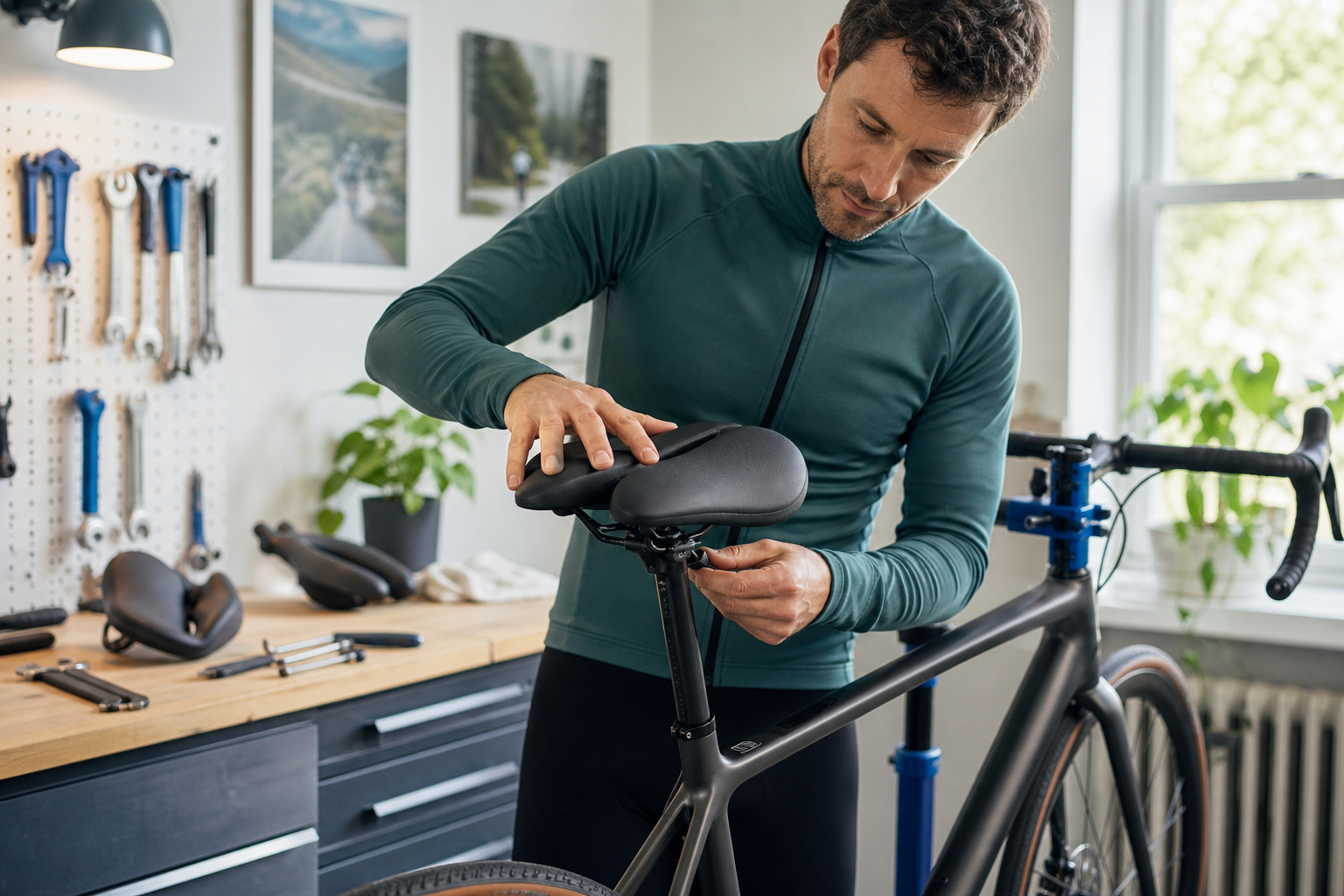
Tailbone pain after cycling is caused by prolonged pressure on the coccyx from the bike saddle, especially when the saddle is too narrow, too hard, or incorrectly positioned. The good news: cycling-related coccyx pain is largely preventable and treatable with the right saddle, fit, and technique.
The Coccyx Relief System: Everything You Need in One Place
Exercises, ergonomic setups, stretches, and a complete daily program. 30+ pages, instant download.
Get My Coccyx Relief SystemInstant download • 30-day money-back guarantee
Table of Contents
- Why Cycling Causes Tailbone Pain
- 5 Specific Causes
- Symptoms: Cycling Coccyx Pain vs Normal Saddle Soreness
- 7 Prevention Strategies
- Best Bike Saddles for Coccyx Pain
- Treatment if Pain Has Already Started
- When to Stop Cycling
- Returning to Cycling After Coccyx Pain
- Frequently Asked Questions
Why Cycling Causes Tailbone Pain
Unlike sitting in a chair, cycling places your weight on a narrow saddle that concentrates force in a small area. The coccyx — which has relatively little surrounding tissue to cushion it — can bear disproportionate load, particularly:
- During sustained pressure over long rides
- When the saddle is positioned too high, causing rocking
- When the saddle nose points upward, tilting the pelvis backward
- When using a saddle too narrow for your sit bone width
- When repeatedly impacting rough terrain, transmitting vibration through the pelvis
The anatomy of the problem
The ischial tuberosities (sitting bones) should bear the majority of your body weight on the saddle. When these are properly supported, the coccyx remains relatively unloaded. When saddle width, tilt, or height is wrong, weight shifts from the ischial tuberosities to the surrounding soft tissue and the coccyx.
5 Specific Causes
1. Wrong Saddle Width
Every person has a different distance between their sitting bones (ischial tuberosity width). Most bike shops have sit bone measuring devices. If your saddle is narrower than your sit bone width, the bones "overhang" the saddle edge and your weight falls onto the soft tissue and coccyx instead.
Solution: Measure your sit bone width and choose a saddle 20–30mm wider than this measurement.
2. Saddle Tilt (Nose Too High)
A saddle with the nose tilting upward is a common setup mistake, particularly among new cyclists. This tilts the pelvis backward (posterior tilt) and loads the soft tissue and coccyx directly.
Solution: Saddle should be level, or with the nose very slightly angled downward (1–3°). Check with a spirit level.
3. Saddle Height Too High
When the saddle is too high, the hips rock side to side with each pedal stroke. This creates a repetitive shearing motion across the coccyx and perineal area.
Solution: At the bottom of the pedal stroke with heel on the pedal, the leg should be almost straight (slight bend of 5–10°). A professional bike fit adjusts this precisely.
4. Insufficient Saddle Padding
Hard, unpadded saddles — common on road and gravel bikes — provide minimal shock absorption. On long rides or rough roads, repeated micro-impacts accumulate significant stress on the coccyx.
Solution: Quality padded cycling shorts (chamois shorts) with at least 8mm multi-density padding in the perineal zone compensate significantly for minimal saddle padding. You should always wear chamois shorts for rides over 1 hour.
5. Riding Without Breaks on Long Sessions
Sustained pressure without movement breaks is the mechanism behind most chronic cycling coccyx injuries. Even with a good saddle, riding for 3+ hours without standing briefly on the pedals, changing position, or stopping allows pressure to accumulate beyond what any saddle can manage.
Solution: Stand on the pedals for 30 seconds every 15–20 minutes on longer rides. Stop and walk around briefly every 60–90 minutes.
Symptoms: Cycling Coccyx Pain vs Normal Saddle Soreness
| Symptom | Normal Saddle Soreness | Cycling Coccyx Pain |
|---|---|---|
| Location | Soft tissue between sit bones, perineum | Base of spine, between buttocks |
| Onset | After riding | During or after riding |
| Recovery time | 24–48 hours with rest | Days to weeks |
| Pain on sitting off bike | No | Yes |
| Pain on rising from sitting | No | Yes (the "stand-up wince") |
| Worsens over time | No | Yes if untreated |
If pain is persisting for more than a week after stopping cycling and is present during normal daily activities (sitting, rising from sitting), this has progressed beyond saddle soreness to coccydynia requiring specific treatment.
Prefer a Structured Recovery Plan? Review the System
Use a step-by-step plan with exercises, setup guidance, and clear pacing prompts.
Get My Coccyx Relief SystemInstant download • 30-day money-back guarantee
7 Prevention Strategies
1. Get a Professional Bike Fit
A qualified fitter adjusts saddle height, tilt, fore-aft position, and handlebar reach to redistribute your weight away from the coccyx and onto your sit bones. Studies suggest approximately 60–70% of recreational cyclists are riding with incorrect saddle height.
Cost: $150–$350 AUD. Worth every cent if you ride regularly.
2. Wear Quality Padded Cycling Shorts
Chamois shorts are not optional for rides over 45 minutes. Look for:
- Multi-density foam padding (not single-density)
- At least 8mm thickness in the perineal and sit bone zone
- Anatomically correct padding placement for your sex
- Anti-bacterial chamois material to prevent infection
Bib shorts vs waist shorts: Bib shorts stay in position better and avoid waistband pressure on the abdomen. Generally preferred for longer rides.
3. Choose the Right Saddle
See the saddle guide below. The key: saddle width matched to your sit bone width, with a central cutout or relief channel if you have existing coccyx sensitivity.
4. Level Your Saddle
Use a spirit level. The saddle should be horizontal or angled very slightly nose-down (never nose-up). Even 2–3° of nose-up tilt significantly increases coccygeal pressure.
5. Adjust Saddle Height Correctly
The simple test: at the bottom of the pedal stroke with your heel on the pedal, your leg should be almost fully extended (slight bend only). If your hips rock, the saddle is too high.
6. Stand and Change Position Regularly
- Stand on the pedals for 15–30 seconds every 15–20 minutes
- Shift your sitting position forward and backward periodically
- Take a brief stop and walk around every 60–90 minutes on longer rides
7. Build Ride Duration Gradually
Many cyclists develop coccyx pain by rapidly increasing ride duration (a common mistake when starting cycling or returning after a break). Increase ride duration by no more than 10–15% per week.
Best Bike Saddles for Coccyx Pain
For Road Cycling
ISM Adamo Racing Noseless saddle design eliminates the coccyx-loading that comes from a traditional saddle nose. No nose means no posterior tilt. Requires an adjustment period for balance but provides unmatched coccyx relief for road cyclists.
Selle Italia SLR Boost Superflow Central cutout channel runs the full length of the saddle. Excellent pressure relief for the coccyx and perineal area. Popular with roadies who cannot give up a conventional saddle shape.
For Recreational/Commuter Cycling
Selle Royal Respiro Wide comfort saddle with deep central channel. Excellent for upright riding positions. Generous padding that still allows efficient pedalling.
Terry Butterfly Gel Designed for women's anatomy but suitable for any rider who benefits from a wider, well-padded saddle with a central cutout. Excellent for recreational and hybrid cyclists.
For Indoor Cycling
Indoor cycling (spin bikes, stationary bikes) causes more coccyx problems than outdoor cycling in many cases because:
- You cannot stand up to relieve pressure
- Spin bike saddles are often narrow and firm
- Sessions are often longer than they seem comfortable
Best option for indoor bikes: Add a gel seat cover with a central cutout, or replace the saddle entirely with one of the above options if the attachment is compatible.
Treatment if Pain Has Already Started
Acute treatment (first 2 weeks)
- Rest from cycling — reduce duration significantly or stop temporarily
- Ice — 15 minutes, 3–4 times daily for the first 48–72 hours
- NSAIDs — ibuprofen or naproxen for inflammation management
- Coccyx cushion — use for all non-cycling sitting
- Review saddle setup — immediately correct any obvious fit issues
If pain persists beyond 2 weeks
See your GP or a sports physiotherapist. You may need:
- Assessment of coccyx injury (X-ray or MRI if fracture suspected)
- Manual physiotherapy for sacrococcygeal joint mobilisation
- Corticosteroid injection if conservative treatment is not providing adequate relief
Post-cycling recovery
After returning to cycling, ice the coccyx area for 15 minutes after rides exceeding 1 hour. This reduces acute inflammatory response before it accumulates.
When to Stop Cycling
Stop cycling and seek assessment if:
- Coccyx pain from cycling is present during daily activities (sitting, rising)
- Pain has not improved after 2 weeks of reduced riding
- Pain is worsening with continued riding
- You experience any numbness, tingling, or changes in bowel/bladder function
You do not necessarily need to stop cycling permanently — but you need a proper assessment and corrected setup before resuming.
Returning to Cycling After Coccyx Pain
When returning after a coccyx injury or coccyx pain episode:
- Get a professional bike fit first — do not return to a setup that caused the problem
- Start with shorter rides — 20–30 minutes maximum initially
- Use padded shorts — non-negotiable for every ride until fully recovered
- Increase duration gradually — 10% per week maximum
- Stand frequently — every 15–20 minutes
- Ice after rides — as a precautionary measure for the first 4–6 weeks back
Frequently Asked Questions
Why does my tailbone hurt after cycling? Tailbone pain after cycling is caused by prolonged pressure on the coccyx from the bike saddle, especially when the saddle is too narrow, too hard, or incorrectly positioned. Poor bike fit and lack of movement breaks compound the problem.
What is the best bike seat for tailbone pain? The best bike seats for tailbone pain have a central cutout or channel that eliminates direct pressure on the coccyx. Top choices include the Selle Royal Respiro for recreational riders, the ISM Adamo Racing for road cyclists, and the Terry Butterfly for women's anatomy.
Should I stop cycling if my tailbone hurts? You do not need to stop entirely, but you should reduce ride duration and intensity until pain subsides. If pain persists beyond two weeks despite saddle and fit adjustments, take a complete break for 7–14 days and seek assessment.
Do padded cycling shorts help with tailbone pain? Yes, significantly. Quality padded cycling shorts (with chamois padding) reduce tailbone pressure by cushioning the sit bone zone. Look for shorts with multi-density foam padding at least 8mm thick.
Can a professional bike fit fix tailbone pain? A professional bike fit is one of the most effective solutions for cycling-related tailbone pain. A qualified fitter will adjust saddle height, tilt, and fore-aft position to redistribute weight properly. Approximately 60–70% of recreational cyclists are riding with incorrect saddle height.
Review the Coccyx Relief System
Review 30+ pages of exercises, practical methods, pacing guidance, and a structured daily plan.
Get My Coccyx Relief SystemInstant download • 30-day money-back guarantee