Cushion Fit Guides
Coccyx Cushion for a Hard Chair: Fit Guide
By Coccyx Relief Editorial Team · Updated 2026-08-20
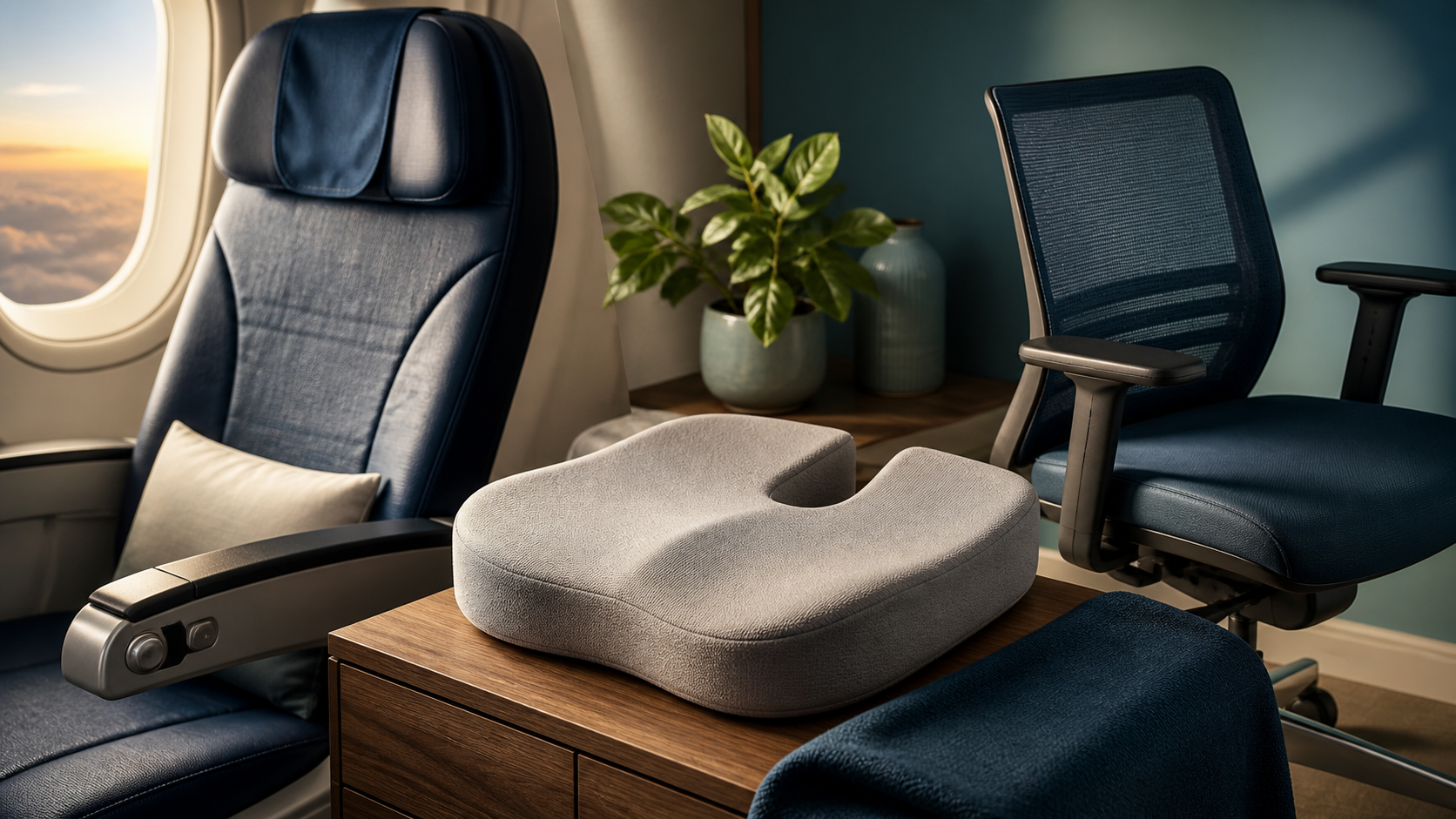
Quick answer: the best coccyx cushion is the one that satisfies the measured constraints of the real setup, not the option with the longest feature list. For people outfitting dining chairs, benches or firm office seating, compare seat-pan depth, usable width, compressed thickness, then verify non-slip base, cutout position, cover care. Use current primary-source specifications, keep health or performance promises separate from product facts, and plan a reversible trial with clear return criteria.
Affiliate disclosure: Coccyx Relief may earn a commission from qualifying purchases made through clearly marked Amazon links. Retailer links are shopping paths, not proof that a product is suitable. We did not hands-on test or clinically evaluate products for this article.
Health boundary: This guide is general information, not diagnosis or individualized care. Seek qualified help for new, severe, progressive or worrying symptoms. Follow urgent-care advice from your local health service.
Table of contents
- Quick answer
- Who this guide is for
- Key takeaways
- Research and evidence method
- Comparison criteria
- Criterion: seat-pan depth
- Criterion: usable width
- Criterion: compressed thickness
- Criterion: non-slip base
- Criterion: cutout position
- Criterion: cover care
- Decision table
- Related guides
- Frequently asked questions
- Sources and update method
- Conclusion
Quick answer
Searching for coccyx cushion for hard chair often produces pages that jump directly from a feature label to a recommendation. This guide uses a spatial fit instead. It translates the query into a footprint, clearance map and fit trial. The result remains understandable even if models, prices or retailer listings change.
No single coccyx cushion is best for every person or setting. The strongest choice is the exact variant that fits the intended environment, is supported by current documentation, and can be returned or changed if the trial exposes a problem. That is a narrower promise than “best,” but it is more honest and more actionable.
Who this guide is for
This article is for people outfitting dining chairs, benches or firm office seating. It is designed for readers who want to compare options carefully without confusing specifications with outcomes. It does not rank unverified models, repeat static prices, invent hands-on testing, or imply that an affiliate destination is independent evidence.
The scope is practical: define the task, measure the environment, compare documented features, check compatibility, and evaluate a real setup. Medical diagnosis, emergency response, individualized treatment, legal compliance and educational sufficiency remain with the appropriate qualified professional or official authority.
Key takeaways
- Start with the job and environment, not a retailer category.
- Treat seat-pan depth and usable width as measurable constraints.
- Verify the exact model, size, hand, format or edition; family-level facts are not enough.
- Separate product identity from comfort, durability, treatment, safety or performance claims.
- Prefer a reversible comparison with written pass and stop criteria.
- Recheck specifications and availability on the day you buy.
Research and evidence method
This hard-chair guide uses a dimensional audit rather than a product ranking. The OSHA chair component guidance supports the neutral checks for seat-pan depth, stable feet and backrest access. Its scope is workstation fit; it does not evaluate add-on cushions or establish symptom improvement.
The OSHA workstation evaluation checklist is used to cross-check width, front-edge contact and adjustability. The Canadian Centre for Occupational Health and Safety chair-adjustment page provides a second institutional reference for chair height and foot support. Product dimensions, base material, zipper position and care still require the exact manufacturer's record.
The NHS tailbone-pain page defines the health boundary and when to seek care. We do not use that page to endorse a retailer item. Sources were checked on 2026-08-20 in Australia/Melbourne; availability and specifications should be reverified on purchase day.
Comparison criteria
The six criteria below turn a broad coccyx cushion for hard chair search into a repeatable comparison. Give each one a status—pass, conditional, fail or unknown—and keep unknowns visible. Do not average away a failed mandatory constraint with several attractive optional features.
Comparison criterion: seat-pan depth
A hard chair should be measured at the exact place where a cushion can lie flat. Rear curves and a waterfall front reduce the usable depth, so record both the maximum surface and the supported rectangle before comparing products.
Measure the clear front-to-back chair surface, not the overall furniture depth. Exclude any rear curve, raised edge or backrest area the cushion cannot occupy. Compare that usable number with the exact cushion depth and check whether the front edge would project beyond the seat. OSHA's chair guidance says seat depth should support most of the thigh without contacting the back of the knee; it does not certify a particular add-on cushion.
Pass when the cushion sits fully on the usable pan, leaves the chair back usable and does not overhang the front. Fail when fitting it requires sitting forward without back support.
Comparison criterion: usable width
Width is governed by the narrowest obstruction, not the broadest part of the seat. Trace arms, rails, raised edges and sculpted bolsters, then compare that outline with the selected cushion rather than a family photograph.
Record the narrowest clear width between arms, side rails or a molded seat rim. A cushion that bows upward at the sides or overlaps a hard edge has not passed the width check even if its headline measurement looks close. Leave a practical handling margin so the cover and zipper are not pinched. For a bench, mark the intended sitting position because there may be no side structure to keep the cushion centered.
Pass when the full cushion lies inside the side boundaries without folding or riding on an arm support. Mark unknown if the seller gives only approximate dimensions.
Comparison criterion: compressed thickness
Thickness changes the dining or desk relationship immediately. Note floor contact, table clearance, armrest interference and backrest contact before and after the cushion is added; those observations matter more than a single catalogue height.
Unloaded thickness is a product dimension; occupied height is a setup observation. Adding any cushion raises the user relative to the floor, table, backrest and armrests. Check whether both feet remain supported and whether the front edge creates new contact behind the thighs. OSHA advises stable foot support when a seat cannot be lowered, but that workstation principle is not evidence of pain relief.
Pass when the adjusted setup preserves stable foot support, usable armrests and a workable table relationship. Stop if the added height creates a new pressure point or unstable posture.
Comparison criterion: non-slip base
Stability comes from the interaction between two surfaces. Identify the chair finish and the cushion underside, preserve both care instructions, and reject a fit that requires an improvised adhesive or damaging grip layer.
Match the base to the actual surface: sealed wood, painted metal, vinyl, woven fabric and textured plastic interact differently. Look for a manufacturer description of the base, then test movement during normal sitting down, standing up and reaching. Do not apply adhesive, abrasive matting or a chemical cleaner without checking both the chair and cushion instructions; a grip fix can damage a finish or create an unstable edge.
Pass when the cushion remains predictably located through ordinary transfers and small position changes. Return it if repeated recentering becomes part of every use.
Comparison criterion: cutout position
The rear channel must remain open and correctly oriented when the cushion sits against the chair back. Map its position on the paper outline without assuming that a visible notch produces a medical effect.
A rear opening only works as a geometric feature when it remains at the rear of the chair and is not covered by the backrest. Compare opening length, width and orientation on the exact model. Sit far enough back to use the chair's support without forcing the cushion into a curved junction. Do not convert the presence of a cutout into a claim about decompression, alignment or a clinical outcome.
Pass when the opening remains correctly oriented while the user can sit against the chair back. Treat shape preference as individual fit, not a universal ranking.
Comparison criterion: cover care
Care is part of hard-chair compatibility because the zipper and underside remain close to an unforgiving surface. Confirm removal, washing, drying and refitting before accepting the design.
Inspect whether the cover is removable, where the zipper sits, and whether the maker distinguishes washing the cover from cleaning the core. A hard dining chair may expose the underside to dust or spills more often than an office chair. Follow the exact care label, allow the cover to dry completely, and confirm that refitting it does not distort the cushion or leave the slider against the chair surface.
Pass when the complete cleaning and drying routine is compatible with normal household use and the chair finish. Keep care instructions with the product.
Decision table
| Criterion | Evidence to capture | Decision use |
|---|---|---|
| seat-pan depth | Record the current constraint and exact variant | Measure before comparing listings |
| usable width | Record the current constraint and exact variant | Verify compatibility and tradeoffs |
| compressed thickness | Record the current constraint and exact variant | Measure before comparing listings |
| non-slip base | Record the current constraint and exact variant | Verify compatibility and tradeoffs |
| cutout position | Record the current constraint and exact variant | Measure before comparing listings |
| cover care | Record the current constraint and exact variant | Verify compatibility and tradeoffs |
Use the table before opening multiple retailer tabs. A written baseline makes it easier to reject irrelevant options and reduces the chance that advertising language will redefine the need. Keep links or screenshots for material specifications, but date them because models and listings change.
Map the hard chair before choosing a cushion
A hard chair creates a simple-looking but unforgiving fit problem. There is little upholstery to absorb an overhang, hide a zipper or stabilize a poorly sized base. Dining chairs, waiting-room chairs, wooden benches and rigid office seats can also have curved backs, side rails or sculpted pans that reduce the usable rectangle. Start with the furniture rather than an online product category.
Draw the usable seat pan
Place a sheet of paper on the chair and trace only the area that can support the cushion. Mark the front edge, the backrest junction and any arms or raised sides. Measure maximum width and depth in millimetres or quarter-inches. Then mark a second, smaller rectangle that excludes rounded corners and slopes. That inner shape is the safer comparison area.
Photograph the ruler in position so another person can repeat the measurement. Product dimensions should come from the exact manufacturer model or current retailer variant. If a listing gives one number for an entire family of sizes or colours, treat the fit as unknown until the selected child is confirmed.
Check the whole chair relationship
A cushion changes more than surface softness. It raises the seated position, may reduce usable backrest height and can bring fixed armrests closer to the body. At a dining table it also changes elbow height relative to the tabletop. At a desk it can change keyboard and monitor relationships. Compare the unmodified chair and cushioned chair with the same footwear and ordinary task.
OSHA's current computer-workstation guidance recommends a seat height that permits the whole sole to rest on the floor and a seat pan that supports the thigh without pressing behind the knee. Those are useful setup checks. They are not a prescription for coccyx pain and do not establish that a cushion treats a condition.
Hard-surface stability check
Clean the chair only as its maker permits and let it dry. Set the cushion squarely on the pan. Sit down and stand up normally several times, then note any forward, sideways or rotational movement. Repeat with the clothes normally worn in that setting. A base that holds on woven upholstery may behave differently on sealed timber or vinyl.
Avoid improvised adhesives or fasteners during the return period. Tape can leave residue, hook material can scratch a finish and a loose shelf liner can create another sliding layer. If the cushion includes a strap, verify that the strap has a safe path around the back without crossing a hinge, control or decorative joint.
Decide from a written fit result
Use four results: fits, fits after a documented chair adjustment, does not fit, or information missing. Keep comfort observations separate from dimensional facts. A product can fit the chair yet be unsuitable for the individual, and it can feel acceptable briefly while failing the table-height or cleaning workflow. The return decision should consider the complete setup rather than one first impression.
Hard-chair fit worksheet
Use a separate worksheet for each chair. Start with a short identifier such as kitchen-oak-1 or meeting-room-blue so measurements are never mixed between similar furniture. Record clear seat depth, narrowest width, height from the floor, backrest junction, arm spacing and surface finish. Add the date and the tool used. This creates a traceable chair record rather than a memory-based estimate.
Next, create one row per cushion candidate. Copy outer width, outer depth, peak height, front-edge height, opening orientation, underside description, closure location and care method from the exact product record. Use unknown when a value is missing. Do not fill a blank from a review, another colour or a product-family page.
Dining-chair check
A dining chair must still approach the table after the cushion is fitted. Measure the vertical space beneath the table apron and check whether thighs, cushion or chair arms reduce clearance. Note elbow position during the real activity without treating one posture as universally ideal. Include how the chair is pulled out and whether the cushion catches when the user stands.
Wooden dining chairs often have a smaller supported area than the visible seat because the rear corners curve around the back uprights. A rectangular cushion can bridge those corners. The paper template should lie flat without being forced beneath a spindle or folded over an edge.
Bench check
A bench lacks the side boundaries that help locate a cushion. Mark the intended position and observe whether the user naturally returns it there. If multiple people share the bench, allow enough space that another sitter does not push or overlap the cushion. Check whether the rear opening is easy to orient when there is no chair back.
Storage can dominate the decision for occasional dining use. Measure the cupboard, shelf or basket where the cushion will go and verify that the core may be stored in that orientation. Do not fold foam or stack heavy objects on it unless its maker permits that treatment.
Rigid office-chair check
On molded plastic or metal seating, check every control and edge after adding height. Ensure the cushion does not cover a seat-depth lever, press against a flexible back hinge or extend into the caster path. Reconfirm monitor and input-device positions after the chair height is adjusted.
For shared chairs, write the original settings and reset steps. If every user needs a different cushion placement, a portable item should be quick to remove and identify. A setup that is routinely left misaligned should be marked conditional even when it fits one user.
Final decision note
Close the worksheet with one sentence: “This exact cushion fits this exact chair because…” Then list any compromise. Keep the receipt, return deadline and model label beside the note. If the sentence depends on an unverified dimension, unsafe workaround or hoped-for health result, the candidate is not ready to keep.
Related guides
These internal resources cover adjacent decisions. Use them to avoid asking one page or product to answer every question in the topic cluster.
Frequently asked questions
How should I measure a hard chair for a coccyx cushion?
Measure the flat, supported rectangle between the front edge, backrest and side structures. Record the narrowest width and usable depth, then compare those figures with the exact cushion. A paper outline reveals overhang and curved-corner conflicts better than comparing headline dimensions alone.
Can a cushion overhang a wooden chair?
Overhang is a fit warning because the edge may fold, move or interfere with standing. Prefer a cushion that is fully supported by the seat pan. If a manufacturer explicitly permits some overhang, confirm the exact limit and test stability without damaging the chair finish.
What if adding the cushion makes my feet dangle?
First lower the chair within its documented adjustment range while keeping the table or desk usable. Where that is impossible, OSHA discusses stable foot support for workstation geometry. Do not accept an unstable position; get individualized advice when health or mobility affects the setup.
Is a non-slip bottom enough on polished wood?
Not necessarily. Non-slip is not a standardized rating and surface finishes vary. Check manufacturer compatibility, remove dust using approved care, and observe normal transfers. Avoid tape, aggressive rubber mesh or cleaners that either maker prohibits.
Should the rear cutout touch the backrest?
The cushion should be oriented exactly as its instructions show while leaving the chair back usable. A backrest that closes the channel or pushes the cushion forward indicates a dimensional mismatch. The cutout's presence alone does not prove a clinical mechanism.
When should I return a hard-chair cushion?
Return it when it overhangs, rocks, repeatedly slides, blocks the backrest, creates unstable foot support, interferes with the table, or cannot be cleaned as required. Stop earlier for new or worsening symptoms and seek qualified care.
Sources and update method
- OSHA: computer-workstation chairs
- OSHA: workstation evaluation checklist
- CCOHS: how to adjust office chairs
- NHS: tailbone (coccyx) pain
Update rule: recheck institutional guidance, every exact product dimension, surface restriction, cover instruction and return condition before a material revision. Retailer availability and search order are not editorial evidence.
Conclusion
A useful coccyx cushion for hard chair decision starts with the real job and ends with a documented trial. Compare seat-pan depth, usable width, compressed thickness, non-slip base, cutout position, cover care; verify the exact variant; preserve unknowns; and keep outcome promises separate from observable product or planning facts. That process will not manufacture certainty, but it will help you make a clearer, safer and more defensible choice.