Cushion Fit Guides
Coccyx Cushion Thickness Guide: Measure Before Buying
By Coccyx Relief Editorial Team · Updated 2026-08-20
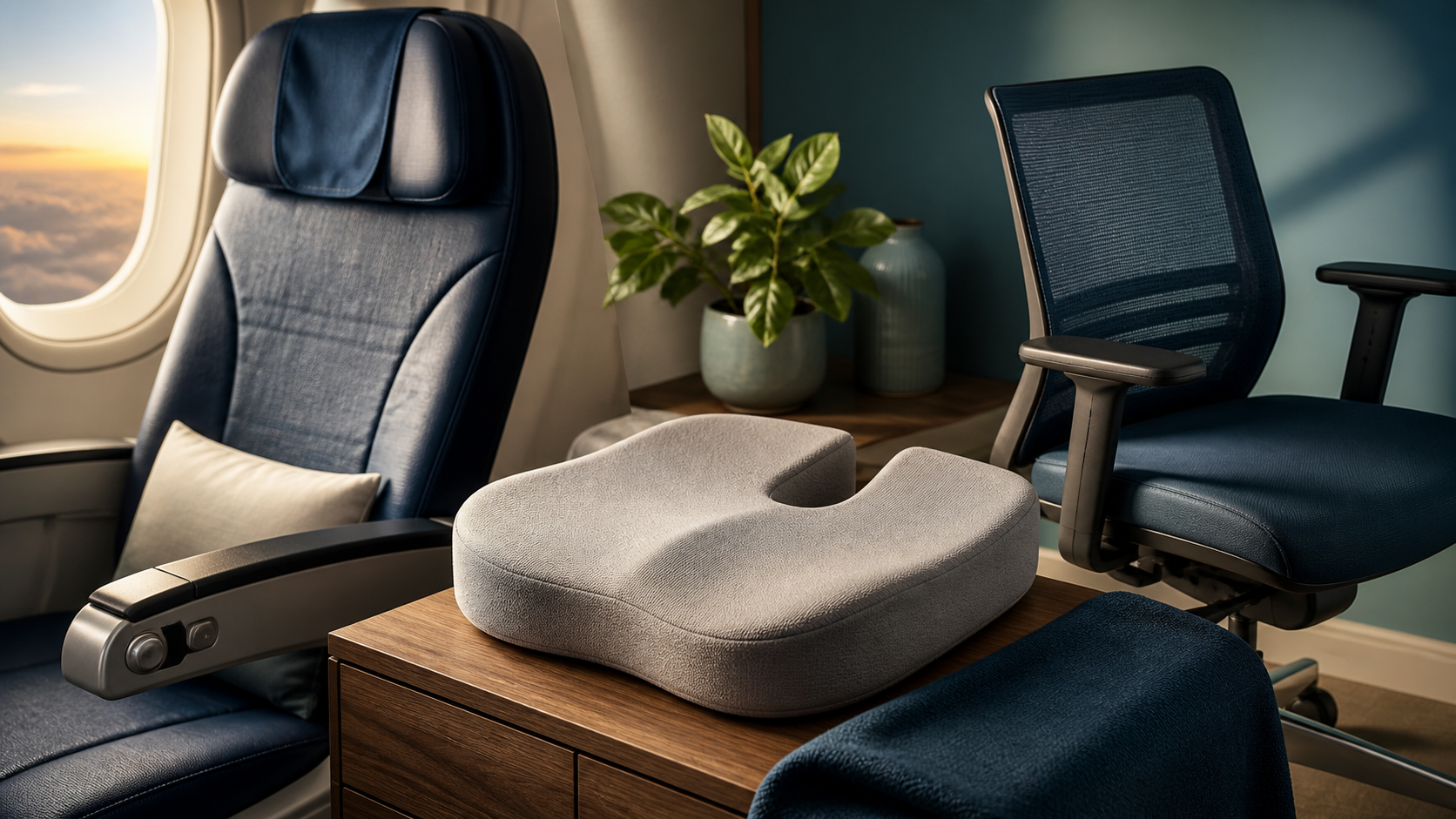
Quick answer: the best cushion thickness is the one that satisfies the measured constraints of the real setup, not the option with the longest feature list. For buyers comparing occupied height rather than uncompressed marketing dimensions, compare unloaded height, compressed height, foot support, then verify armrest change, backrest contact, edge pressure. Use current primary-source specifications, keep health or performance promises separate from product facts, and plan a reversible trial with clear return criteria.
Affiliate disclosure: Coccyx Relief may earn a commission from qualifying purchases made through clearly marked Amazon links. Retailer links are shopping paths, not proof that a product is suitable. We did not hands-on test or clinically evaluate products for this article.
Health boundary: This guide is general information, not diagnosis or individualized care. Seek qualified help for new, severe, progressive or worrying symptoms. Follow urgent-care advice from your local health service.
Table of contents
- Quick answer
- Who this guide is for
- Key takeaways
- Research and evidence method
- Comparison criteria
- Criterion: unloaded height
- Criterion: compressed height
- Criterion: foot support
- Criterion: armrest change
- Criterion: backrest contact
- Criterion: edge pressure
- Decision table
- Related guides
- Frequently asked questions
- Sources and update method
- Conclusion
Quick answer
Searching for coccyx cushion thickness often produces pages that jump directly from a feature label to a recommendation. This guide uses a operating workflow instead. It translates the query into a handoff, operating routine and maintenance path. The result remains understandable even if models, prices or retailer listings change.
No single cushion thickness is best for every person or setting. The strongest choice is the exact variant that fits the intended environment, is supported by current documentation, and can be returned or changed if the trial exposes a problem. That is a narrower promise than “best,” but it is more honest and more actionable.
Who this guide is for
This article is for buyers comparing occupied height rather than uncompressed marketing dimensions. It is designed for readers who want to compare options carefully without confusing specifications with outcomes. It does not rank unverified models, repeat static prices, invent hands-on testing, or imply that an affiliate destination is independent evidence.
The scope is practical: define the task, measure the environment, compare documented features, check compatibility, and evaluate a real setup. Medical diagnosis, emergency response, individualized treatment, legal compliance and educational sufficiency remain with the appropriate qualified professional or official authority.
Key takeaways
- Start with the job and environment, not a retailer category.
- Treat unloaded height and compressed height as measurable constraints.
- Verify the exact model, size, hand, format or edition; family-level facts are not enough.
- Separate product identity from comfort, durability, treatment, safety or performance claims.
- Prefer a reversible comparison with written pass and stop criteria.
- Recheck specifications and availability on the day you buy.
Research and evidence method
This article separates published thickness from the geometry observed after a cushion is added to a chair. The Occupational Safety and Health Administration chair guidance is the primary reference for seat height, foot support, seat depth and backrest access. It does not supply a preferred cushion thickness.
The OSHA workstation purchasing guide adds desk-clearance context, while the Canadian Centre for Occupational Health and Safety chair guide reinforces adjustability and supported feet. We translate those points into a thickness budget without prescribing a universal angle, height or sitting duration.
For health boundaries, we link to the National Health Service coccyx-pain guidance. No institutional source here validates a brand, foam core or relief claim. The evidence review date is 2026-08-20; exact model records remain purchase-day facts.
Comparison criteria
The six criteria below turn a broad coccyx cushion thickness search into a repeatable comparison. Give each one a status—pass, conditional, fail or unknown—and keep unknowns visible. Do not average away a failed mandatory constraint with several attractive optional features.
Comparison criterion: unloaded height
Treat maximum height as the start of the measurement, not the answer. Locate the peak, front edge and slope on the chosen model so two differently contoured products are not compared as though their numbers describe the same point.
Record the maker's maximum or nominal height at the thickest point and note where that point sits. A wedge may have two very different edge heights, while a contoured cushion may be tallest away from the center. Do not compare a front-edge measurement on one model with a rear peak on another. If the measurement method is absent, label the value nominal rather than precise.
Pass when published height is tied to the exact model and measurement location. Keep the comparison conditional when only an unsourced marketplace diagram supplies the number.
Comparison criterion: compressed height
Occupied height is an observation made in the complete chair, not a promise derivable from foam terminology. Watch for bottoming, uneven collapse and slow movement while respecting the maker's stated limits.
Foam compression depends on construction, load, temperature and time, so a universal occupied-height number cannot be inferred from an unloaded specification. Observe the candidate during ordinary use without claiming a laboratory result. The useful question is whether it bottoms out, remains stable and preserves the surrounding chair relationships for the intended user.
Pass when ordinary use does not collapse the core to an unstable hard spot or change the cushion's position. Do not publish the personal result as a universal capacity claim.
Comparison criterion: foot support
Foot support is the first surrounding-system check after height changes. Re-adjust the chair safely, verify the task surface, and keep any footrest stable; dangling feet are not an acceptable hidden tradeoff.
Adding height can leave feet unsupported. OSHA recommends lowering the chair when possible or using a stable footrest when the seat cannot be lowered without making the workstation too high. First check the chair's safe adjustment range and the desk relationship. A footrest is a workstation component, not proof that the cushion is medically appropriate.
Pass when both feet have stable support after all permitted chair adjustments and the work surface remains usable. Stop if the user must perch forward to reach the floor.
Comparison criterion: armrest change
Fixed arms can become effectively lower when the body is raised. Confirm shoulder clearance, desk approach and access to chair controls before deciding that a thickness fits.
Raising the body changes the relative height of fixed armrests. Check whether shoulders remain relaxed and whether the arms block the chair from approaching the desk. Adjustable rests may solve the geometry; fixed arms may turn an otherwise acceptable cushion into a failed fit. Measure both sides because some chairs include asymmetric controls or tablet arms.
Pass when armrests still support rather than crowd and the chair can approach the task surface. Remove or adjust them only if the chair maker permits it.
Comparison criterion: backrest contact
Backrest contact can disappear when added material moves the user forward. Evaluate the lower back zone and the curved rear of the pan together rather than looking at cushion height by itself.
A thicker cushion may move the pelvis forward of a shaped backrest or reduce contact with the lower portion of the back. Test whether the user can sit against the support without the cushion being forced up the rear curve. Do not use a cushion to compensate for a broken or unsuitable chair; evaluate the base furniture independently.
Pass when the chair back remains usable without pushing the cushion forward. A cushion that consumes needed backrest depth fails the configuration even if its listed height is attractive.
Comparison criterion: edge pressure
Front-edge shape decides where the added height meets the thighs. Inspect taper, seam and projection after an ordinary session, then compare that result with the empty chair baseline.
Inspect the front transition while seated in normal clothing. The edge should not create concentrated contact behind the thighs, and it should not project beyond the chair where it can catch during standing. Compare edge shape as well as peak thickness. A tapered front and a square block with the same maximum height can interact very differently with a seat pan.
Pass when the front edge supports a normal sitting position without a new hard contact or transfer obstruction. Check again after the foam has been occupied for a typical session.
Decision table
| Criterion | Evidence to capture | Decision use |
|---|---|---|
| unloaded height | Record the current constraint and exact variant | Measure before comparing listings |
| compressed height | Record the current constraint and exact variant | Verify compatibility and tradeoffs |
| foot support | Record the current constraint and exact variant | Measure before comparing listings |
| armrest change | Record the current constraint and exact variant | Verify compatibility and tradeoffs |
| backrest contact | Record the current constraint and exact variant | Measure before comparing listings |
| edge pressure | Record the current constraint and exact variant | Verify compatibility and tradeoffs |
Use the table before opening multiple retailer tabs. A written baseline makes it easier to reject irrelevant options and reduces the chance that advertising language will redefine the need. Keep links or screenshots for material specifications, but date them because models and listings change.
Thickness is a system change, not one number
Search listings usually describe cushion thickness as if more or less were automatically better. The real decision is geometric: adding material changes the height of the user relative to the floor, backrest, armrests, desk, steering controls or table. The same cushion can fit one chair and disrupt another. Compare the entire seated system.
Separate three height measurements
Write down the unloaded maximum height, the height at the front edge and the observed occupied height for the intended user. These values answer different questions. Maximum height helps compare product envelopes; front height relates to the chair edge; occupied height shows how the setup actually changes under ordinary use. Do not invent occupied figures from foam density or customer reviews.
For wedges and contoured designs, draw a side profile. Mark which end faces forward, where the cutout begins and whether the maker's dimensions include the cover. Screenshots should show the exact variant name and date because sellers may reuse a diagram across sizes.
Preserve floor and desk support
Before adding anything, set the chair for the task and note seat height, foot contact, armrest position and desk clearance. Add the cushion, then lower the chair only within its documented range. If the feet no longer rest stably, review the setup rather than accepting dangling feet as the price of extra padding.
The U.S. Occupational Safety and Health Administration says an overly high chair can leave feet unsupported or encourage sitting forward away from the backrest. Its guidance suggests a stable footrest when the seat cannot be lowered because doing so would make the keyboard or monitor too high. This is an ergonomic boundary for workstation setup, not a treatment claim.
Test compression without fake precision
An at-home check cannot establish material density, durability or clinical performance. It can reveal practical fit. Photograph the empty profile, sit for a normal short task and photograph it again from the same angle. Note whether the core rebounds, whether one edge folds and whether the base moves. Avoid deliberately overloading a product or testing beyond the manufacturer's limits.
Do the comparison at the times and room conditions that matter. Some foams feel firmer when cool and change gradually with warmth. Record the observation in plain language rather than presenting it as a controlled laboratory measurement.
Use a thickness budget
Create a simple budget with four lines: available chair adjustment, required foot support, usable backrest contact and task-surface clearance. A candidate passes only if every mandatory line remains workable. This prevents a comfortable-feeling first minute from hiding a desk or transfer problem.
Return when geometry cannot be corrected
Stop the trial when the cushion causes unstable feet, pushes the user away from the back, interferes with safe chair controls, creates a new edge contact or repeatedly slides because it is too tall for the pan. Keep health judgments with a qualified clinician. The consumer decision here is whether the exact cushion height integrates with the exact chair.
Create a chair-height budget
A chair-height budget tracks every relationship affected by added thickness. Begin without the cushion and record seat height from the floor, distance from the seat to the underside of the desk or table, backrest contact point and armrest clearance. Use the same chair setting, footwear and task for the comparison. Photographs from the side help show changes that are easy to overlook.
Add the candidate and repeat the measurements after an ordinary short session. Do not claim that the occupied figure is a product specification; label it as a personal setup observation with date and context. If another person uses the chair, create a second row rather than averaging both people into a meaningless number.
Low-profile cushions
A lower profile may preserve table and backrest geometry, yet its core can still behave differently depending on contour and construction. Check whether the front edge is tapered and whether the rear opening remains clear. Low headline height does not guarantee stability, comfort or durability.
If the chair already sits near the bottom of its adjustment range, a lower profile can leave more correction room. Record how much safe adjustment remains rather than assuming the gas lift or legs can move farther than documented.
Taller and wedge-shaped cushions
For a wedge, note both front and rear height and draw the slope direction. A product marketed as four inches thick may reach that figure only at one edge. Compare the complete profile with a flat cushion using two or three corresponding points.
Taller designs deserve an early clearance check. Sit at the table or desk and verify that knees, thighs, armrests and any chair arms still pass beneath fixed structures. In a vehicle, do not alter seating geometry or sightlines based on this general guide; follow the vehicle maker and qualified advice.
Shared-chair adjustment card
Write the unmodified chair setting, the cushioned setting and the reset sequence. Use existing chair marks or a removable note rather than adding permanent markings without permission. The sequence should name height, seat depth, armrests and foot support in the order they are checked.
If a user cannot safely operate the controls while seated, follow the chair manual and obtain help. Do not crawl under a loaded chair, modify a gas cylinder or block a control to preserve a cushion setup.
A practical compression record
Use descriptive categories: retains clearance, approaches the seat pan, or reaches a hard contact. Add elapsed ordinary-use time and room conditions. Avoid percentages unless measured by an appropriate method. Compare the same task twice before deciding that a one-off change represents the product.
Keep, exchange or stop
Keep only when the height budget passes every mandatory relationship and the care routine is practical. Exchange when another documented profile could solve a dimensional failure within the return period. Stop when height introduces unstable feet, blocked controls, lost backrest support, difficult transfers or a new concentrated edge. Health outcomes remain outside this worksheet.
Related guides
These internal resources cover adjacent decisions. Use them to avoid asking one page or product to answer every question in the topic cluster.
Frequently asked questions
What coccyx cushion thickness should I buy?
There is no universal best thickness. Choose the smallest documented geometry that fits the chair while preserving stable feet, backrest contact, armrest clearance and task height. Compare peak and front-edge height, then observe occupied height without presenting it as a laboratory measurement.
Why does compressed height matter?
Unloaded height tells you the product envelope; compressed height shows the practical change under ordinary use. Construction, load, temperature and time influence compression, so do not borrow another reviewer's result. Test the exact model within the return window.
Can a thick cushion make a chair too high?
Yes. Added height may leave feet unsupported, lower fixed armrests relative to the body, or move the user above a desk. Reconfigure only within documented chair limits and keep all surrounding relationships in the pass/fail record.
Should I use a footrest with a seat cushion?
A stable footrest may support feet when a workstation seat cannot be lowered, as OSHA discusses. It should not be used to rationalize a cushion that otherwise does not fit, and it does not make the product medically suitable.
How can I tell whether foam bottoms out?
Observe whether the core reaches a hard, unstable spot during a normal permitted session and whether it rebounds afterward. Do not deliberately overload it. A recurring hard contact is a practical return signal, not a diagnosis of foam density.
Does a thicker cushion relieve more tailbone pain?
Thickness alone cannot establish relief. Product dimensions and personal comfort are different evidence categories. Seek clinical advice for persistent, severe or worsening symptoms, and keep the consumer comparison focused on fit, stability, care and returnability.
Sources and update method
- OSHA: chair height, seat pan and foot support
- OSHA: workstation purchasing guide
- CCOHS: ergonomic-chair considerations
- NHS: coccyx-pain information
Update rule: revise if responsible ergonomic guidance changes or an exact referenced height, profile, chair instruction or care record changes. Preserve unknown compression values rather than estimating them.
Conclusion
A useful coccyx cushion thickness decision starts with the real job and ends with a documented trial. Compare unloaded height, compressed height, foot support, armrest change, backrest contact, edge pressure; verify the exact variant; preserve unknowns; and keep outcome promises separate from observable product or planning facts. That process will not manufacture certainty, but it will help you make a clearer, safer and more defensible choice.