Cushion Fit Guides
Donut Pillow vs Coccyx Cushion: Fit Differences
By Coccyx Relief Editorial Team · Updated 2026-08-20
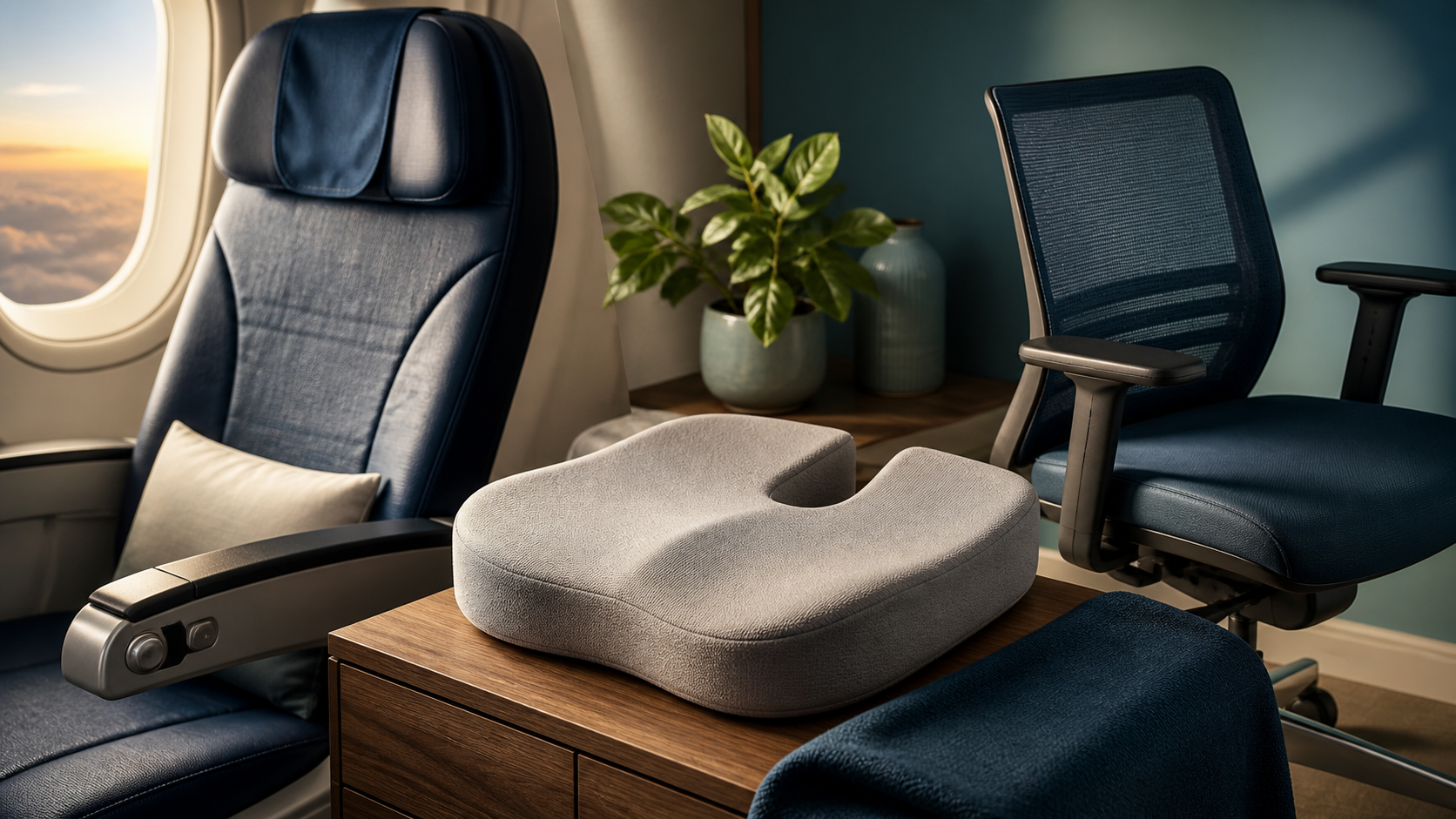
Quick answer: the best seat cushion shape is the one that satisfies the measured constraints of the real setup, not the option with the longest feature list. For sitters comparing ring, U-cutout and wedge designs, compare opening location, pelvic support area, compressed height, then verify chair fit, surface stability, return trial. Use current primary-source specifications, keep health or performance promises separate from product facts, and plan a reversible trial with clear return criteria.
Affiliate disclosure: Coccyx Relief may earn a commission from qualifying purchases made through clearly marked Amazon links. Retailer links are shopping paths, not proof that a product is suitable. We did not hands-on test or clinically evaluate products for this article.
Health boundary: This guide is general information, not diagnosis or individualized care. Seek qualified help for new, severe, progressive or worrying symptoms. Follow urgent-care advice from your local health service.
Table of contents
- Quick answer
- Who this guide is for
- Key takeaways
- Research and evidence method
- Comparison criteria
- Criterion: opening location
- Criterion: pelvic support area
- Criterion: compressed height
- Criterion: chair fit
- Criterion: surface stability
- Criterion: return trial
- Decision table
- Related guides
- Frequently asked questions
- Sources and update method
- Conclusion
Quick answer
Searching for donut pillow vs coccyx cushion often produces pages that jump directly from a feature label to a recommendation. This guide uses a evidence audit instead. It translates the query into a record, source trail and acceptance test. The result remains understandable even if models, prices or retailer listings change.
No single seat cushion shape is best for every person or setting. The strongest choice is the exact variant that fits the intended environment, is supported by current documentation, and can be returned or changed if the trial exposes a problem. That is a narrower promise than “best,” but it is more honest and more actionable.
Who this guide is for
This article is for sitters comparing ring, U-cutout and wedge designs. It is designed for readers who want to compare options carefully without confusing specifications with outcomes. It does not rank unverified models, repeat static prices, invent hands-on testing, or imply that an affiliate destination is independent evidence.
The scope is practical: define the task, measure the environment, compare documented features, check compatibility, and evaluate a real setup. Medical diagnosis, emergency response, individualized treatment, legal compliance and educational sufficiency remain with the appropriate qualified professional or official authority.
Key takeaways
- Start with the job and environment, not a retailer category.
- Treat opening location and pelvic support area as measurable constraints.
- Verify the exact model, size, hand, format or edition; family-level facts are not enough.
- Separate product identity from comfort, durability, treatment, safety or performance claims.
- Prefer a reversible comparison with written pass and stop criteria.
- Recheck specifications and availability on the day you buy.
Research and evidence method
The donut-versus-cutout comparison is intentionally limited to visible and documented geometry. The OSHA chair guidance informs the checks for usable seat depth, thigh support, foot contact and backrest use. It does not compare rings with U-shaped cushions and cannot support a superiority claim.
The OSHA evaluation checklist provides a repeatable chair-fit framework. We add manufacturer drawings for the exact outer footprint, opening, height and orientation; marketplace category labels are insufficient when the diagrams are missing or conflict.
The NHS page on tailbone pain is cited only for general health context and care-seeking boundaries. It is not evidence that one opening shape is clinically better. This comparison was reviewed on 2026-08-20 and must be refreshed if responsible guidance or referenced product forms change.
Comparison criteria
The six criteria below turn a broad donut pillow vs coccyx cushion search into a repeatable comparison. Give each one a status—pass, conditional, fail or unknown—and keep unknowns visible. Do not average away a failed mandatory constraint with several attractive optional features.
Comparison criterion: opening location
Begin with a scaled drawing of the opening. Ring, donut, U-shaped and rear-cutout labels are inconsistent, so establish whether the void is enclosed or reaches the rear and where it sits inside the outer edge.
Map the void rather than relying on the words donut, ring, U-shaped or coccyx. A ring has a central opening; many coccyx cushions have a rear channel that reaches the back edge; some wedges add a slope. Measure the opening and its distance from the front edge on the exact model. Product category names do not establish where the user's anatomy will sit.
Pass when the opening type, dimensions and orientation are documented for the selected model. Reject vague shape labels that cannot be reconciled to a diagram.
Comparison criterion: pelvic support area
Calculate usable supporting surface from the full outline and opening together. A photograph cannot show whether enough stable material remains at each edge, and geometry must not be presented as measured pressure performance.
Compare how much intact surface remains at the front, sides and rear. A large opening inside a compact outer footprint leaves less supporting area than the same opening in a larger cushion. This is a geometry observation, not a pressure-distribution claim. Exclude products whose maker does not publish enough information to understand the selected shape.
Pass when the outer surface remains fully supported by the chair and provides a usable sitting area. Do not claim how body pressure is distributed without applicable test evidence.
Comparison criterion: compressed height
Control thickness while comparing shape. If one candidate is substantially taller or more sloped, record that as a separate variable affecting feet, backrest and desk rather than attributing every difference to the opening.
Ring and rear-cutout cushions can differ in peak height, edge height and slope. Use the same unloaded and occupied-height checks for both: feet, chair back, armrests and work surface must still function together. Do not interpret extra thickness as extra relief or convert a visual contour into evidence of pelvic alignment.
Pass when the chosen shape preserves stable feet, backrest contact and task height. Compare height separately from the opening design.
Comparison criterion: chair fit
Chair fit can eliminate a shape before any personal trial. Use templates to find collisions with a curved back, sculpted pan, arms or narrow front and reject models that require an unintended orientation.
Place a full-scale paper outline on the actual chair. A complete ring opening can be compromised by a sculpted pan, while a rear channel can be obstructed by a curved backrest. Check overhang, usable seat depth and transfer clearance. A shape comparison without chair dimensions is incomplete.
Pass when the paper template and physical trial both remain inside the usable seat pan. A model that works only when turned contrary to its instructions fails.
Comparison criterion: surface stability
Directional stability matters because an opening that rotates or slides is no longer positioned as designed. Match base, contour and approved strap path to the real chair surface.
Evaluate base material, outer contour and any strap on the intended surface. Ring shapes can rotate; rear-opening cushions can drift forward or sideways. Observe ordinary transfers and reaching without intentionally provoking a slip. If stability depends on an unapproved adhesive or unsafe strap path, the fit has failed.
Pass when the cushion keeps its orientation during normal entry, exit and small movements. Repeated rotation is a meaningful failure for a directional opening.
Comparison criterion: return trial
A return window is an essential comparison criterion when shape preference is uncertain. Check hygiene rules, packaging and deadlines before trying either option in ordinary conditions.
Because shape preference cannot be resolved from specifications alone, verify the return window, hygiene exclusions and packaging requirements before use. Keep the cover clean and follow the seller's trial conditions. A reversible A/B comparison is more honest than declaring one shape best for everybody.
Pass when the buyer can conduct a clean, permitted trial and return the item if geometry is wrong. Record the deadline before removing packaging.
Decision table
| Criterion | Evidence to capture | Decision use |
|---|---|---|
| opening location | Record the current constraint and exact variant | Measure before comparing listings |
| pelvic support area | Record the current constraint and exact variant | Verify compatibility and tradeoffs |
| compressed height | Record the current constraint and exact variant | Measure before comparing listings |
| chair fit | Record the current constraint and exact variant | Verify compatibility and tradeoffs |
| surface stability | Record the current constraint and exact variant | Measure before comparing listings |
| return trial | Record the current constraint and exact variant | Verify compatibility and tradeoffs |
Use the table before opening multiple retailer tabs. A written baseline makes it easier to reject irrelevant options and reduces the chance that advertising language will redefine the need. Keep links or screenshots for material specifications, but date them because models and listings change.
Ring opening and rear cutout: the real distinction
The phrase donut pillow versus coccyx cushion mixes marketing names with geometry. A donut or ring generally surrounds a closed central opening. A typical coccyx cushion uses a channel or notch that opens through the rear edge. Wedge cushions introduce a third variable: front-to-back slope. Products do not always follow these conventions, so the exact diagram matters more than the title.
Compare the void and the outer footprint
Trace each candidate at full size using published length and width. Draw the opening inside it, including its distance from the front and side edges. This reveals how much of the cushion remains around the void and whether the opening can stay clear of the chair structure. Do not infer where a body will load the surface from a product photo.
A circular opening may allow the cushion to be rotated, but rotation can also make orientation less predictable. A rear channel makes direction obvious and may interact strongly with a chair's back curve. Neither observation proves clinical superiority. The question is which documented geometry fits the chair and the individual's clinician-informed requirements.
Control height as a separate variable
Shape comparisons become misleading when the ring is much thicker than the rear-cutout option. Record maximum, front-edge and observed occupied height for each. Then check feet, backrest, arms and task surface. If possible, compare candidates with similar outer dimensions so the opening is the main changing variable.
The setup should not force the user forward simply to place the opening. OSHA's chair guidance emphasizes a seat pan that supports the thighs without contacting the back of the knees and allows the backrest to be used. This provides a neutral fit check, not evidence that one cushion style treats coccyx pain.
Consider transfers and directional stability
Watch what happens when sitting down and standing up normally. Does a ring rotate? Does a U-cutout model slide forward and close the intended rear space? Does the front edge catch clothing or project past the chair? These are observable compatibility results.
Straps are not automatically better. A strap must fit the chair without crossing controls, hinges or moving parts, and the manufacturer must allow its use. A non-slip base should be evaluated on the actual material because fabric, vinyl, sealed wood and textured plastic behave differently.
Run a clean A/B trial
Define the comparison before opening the first package: same chair, same task, similar session length and no simultaneous furniture changes. Record fit, stability, setup time, heat, cleaning and whether the backrest remains usable. Stop for new or worsening symptoms and obtain qualified advice rather than extending a product experiment.
Avoid shape mythology
Do not claim that a ring automatically offloads, a U-cutout necessarily decompresses, or a wedge corrects posture. Those are outcome or mechanism claims requiring applicable evidence. This guide compares outer dimensions, void placement, height, stability, care and returnability. When clinical shape advice is needed, ask a qualified professional who knows the individual context.
Shape-comparison worksheet
Create two columns headed ring and rear opening. Under each, record outer length, outer width, maximum height, front height, opening length, opening width, opening position and intended orientation. Add a third column for a wedge only when slope is a real candidate. This prevents marketing names from replacing geometry.
Draw each outer boundary on paper at full scale. Cut out the opening shown in the manufacturer's diagram, but mark uncertain dimensions with a dashed line. Place the templates on the chair separately and photograph their relationship to the backrest, front edge and arms. A template cannot predict personal comfort; it can eliminate obvious physical mismatches.
Enclosed-ring questions
For a ring, find out whether the opening is centered or offset and whether the outer profile is circular, oval or rectangular. Check orientation marks and any slope. Observe whether normal entry rotates the cushion enough to alter the opening position.
The complete perimeter must remain supported. If the chair pan is narrow at the front, a broad ring may hang over both sides even though the center looks stable. Do not crop or fold a cushion to make the outline fit.
Rear-channel questions
For a U- or V-shaped rear channel, measure how far it extends forward and how wide it is at the back edge. Check whether the backrest closes that space or pushes the product forward. Verify which edge is the front; product photography can be ambiguous when contours are symmetrical.
Some rear-cutout cushions are wedges and others are substantially flat. Keep opening form and slope as separate comparison rows. A preference observed with one wedge cannot be attributed solely to its cutout.
Compare covers and cleaning
Ring and channel shapes can make covers more difficult to remove and refit. Inspect seam placement around the void, zipper opening length and any underside coating. A replacement shell must preserve the opening rather than stretching across it.
Record drying method and turnaround because a contoured shell may take longer to dry flat. If the trial product is returnable only in clean condition, understand those rules before use.
Decision matrix without a fake score
Use pass, conditional, fail and unknown for chair footprint, opening documentation, height relationship, directional stability, cleaning and return terms. Do not add the rows into a numeric total: a failed mandatory footprint cannot be outweighed by an easy-to-wash cover.
Write why any conditional result is tolerable and who will resolve an unknown. The final selection should name the exact shape and exact chair. If neither candidate passes, that is a valid conclusion; do not force a winner because the article title uses versus.
Clinical boundary
Bring the dimensional worksheet to a qualified clinician if individualized advice is needed. It can help describe available shapes without implying that the guide chose a treatment. Seek care for severe, progressive, persistent or otherwise concerning symptoms according to local guidance.
Related guides
These internal resources cover adjacent decisions. Use them to avoid asking one page or product to answer every question in the topic cluster.
Frequently asked questions
What is the difference between a donut pillow and a coccyx cushion?
A donut usually has an enclosed central opening. Many coccyx cushions use a channel that opens through the rear edge, sometimes with a wedge profile. Names vary, so confirm the exact diagram, outer dimensions and intended orientation rather than relying on the listing title.
Is a U-shaped cushion better than a donut?
No universal winner can be established from shape alone. Compare chair footprint, opening position, occupied height, stability, cleaning and return terms. Clinical suitability depends on the individual and should not be inferred from a product category.
Can I turn a rear-cutout cushion sideways?
Use only the orientation shown by its maker. Turning a directional cushion can change slope, support area and stability. If it fits the chair only when rotated contrary to instructions, select another geometry.
Why does the chair template matter?
The template shows whether the outer surface is fully supported and whether a curved back closes the opening. It also helps hold size constant while comparing ring and channel designs. Product photos rarely reveal those boundaries accurately.
How do I compare two shapes fairly?
Use the same chair, task and surrounding setup. Change only the cushion, keep session conditions similar, and record geometry separately from subjective comfort. Stop rather than extending the trial through new or worsening symptoms.
Are donut and coccyx cushions medical devices?
Do not assume regulatory status or treatment capability from a retailer name. Check the exact manufacturer's claims and applicable regulator record. This guide makes no diagnosis, prevention, decompression or recovery claim for either design.
Sources and update method
- OSHA: chair component guidance
- OSHA: seating evaluation checklist
- NHS: tailbone-pain overview and care boundary
Update rule: repeat the geometry review when product forms, diagrams, orientation instructions or return conditions change. No source is stretched into a ring-versus-cutout clinical comparison.
Conclusion
A useful donut pillow vs coccyx cushion decision starts with the real job and ends with a documented trial. Compare opening location, pelvic support area, compressed height, chair fit, surface stability, return trial; verify the exact variant; preserve unknowns; and keep outcome promises separate from observable product or planning facts. That process will not manufacture certainty, but it will help you make a clearer, safer and more defensible choice.