Cushion Fit Guides
How to Stop a Seat Cushion Sliding on a Chair
By Coccyx Relief Editorial Team · Updated 2026-08-20
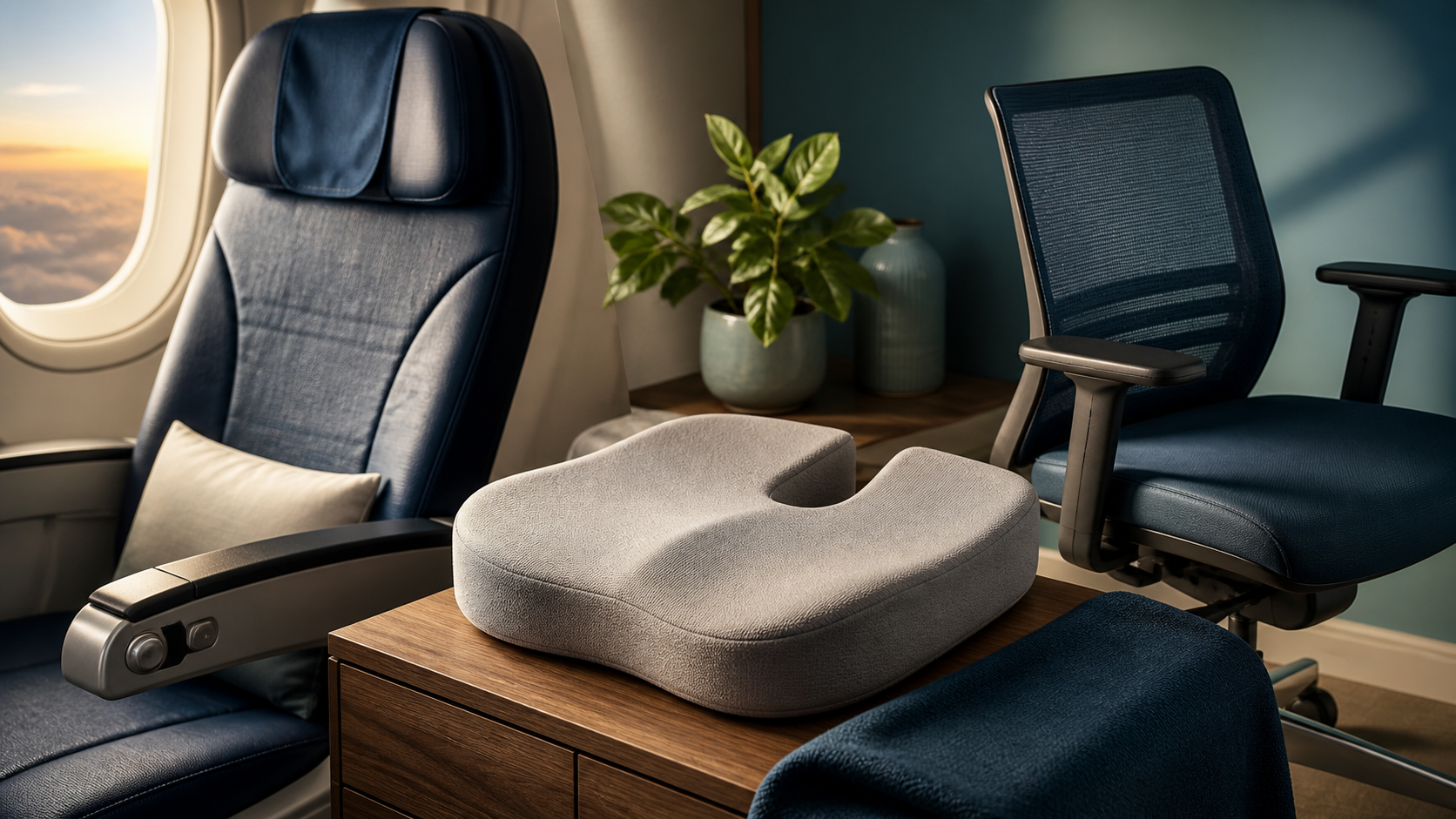
Quick answer: the best seat-cushion stability is the one that satisfies the measured constraints of the real setup, not the option with the longest feature list. For people whose cushion moves on leather, fabric, mesh or molded seats, compare base material, chair contour, cover tension, then verify strap design, surface cleanliness, movement pattern. Use current primary-source specifications, keep health or performance promises separate from product facts, and plan a reversible trial with clear return criteria.
Affiliate disclosure: Coccyx Relief may earn a commission from qualifying purchases made through clearly marked Amazon links. Retailer links are shopping paths, not proof that a product is suitable. We did not hands-on test or clinically evaluate products for this article.
Health boundary: This guide is general information, not diagnosis or individualized care. Seek qualified help for new, severe, progressive or worrying symptoms. Follow urgent-care advice from your local health service.
Table of contents
- Quick answer
- Who this guide is for
- Key takeaways
- Research and evidence method
- Comparison criteria
- Criterion: base material
- Criterion: chair contour
- Criterion: cover tension
- Criterion: strap design
- Criterion: surface cleanliness
- Criterion: movement pattern
- Decision table
- Related guides
- Frequently asked questions
- Sources and update method
- Conclusion
Quick answer
Searching for stop seat cushion sliding often produces pages that jump directly from a feature label to a recommendation. This guide uses a tradeoff comparison instead. It translates the query into a decision matrix, tradeoff ledger and must-have test. The result remains understandable even if models, prices or retailer listings change.
No single seat-cushion stability is best for every person or setting. The strongest choice is the exact variant that fits the intended environment, is supported by current documentation, and can be returned or changed if the trial exposes a problem. That is a narrower promise than “best,” but it is more honest and more actionable.
Who this guide is for
This article is for people whose cushion moves on leather, fabric, mesh or molded seats. It is designed for readers who want to compare options carefully without confusing specifications with outcomes. It does not rank unverified models, repeat static prices, invent hands-on testing, or imply that an affiliate destination is independent evidence.
The scope is practical: define the task, measure the environment, compare documented features, check compatibility, and evaluate a real setup. Medical diagnosis, emergency response, individualized treatment, legal compliance and educational sufficiency remain with the appropriate qualified professional or official authority.
Key takeaways
- Start with the job and environment, not a retailer category.
- Treat base material and chair contour as measurable constraints.
- Verify the exact model, size, hand, format or edition; family-level facts are not enough.
- Separate product identity from comfort, durability, treatment, safety or performance claims.
- Prefer a reversible comparison with written pass and stop criteria.
- Recheck specifications and availability on the day you buy.
Research and evidence method
This troubleshooting guide is based on observation of the chair–cushion interface, not a claim that a generic grip product works everywhere. The OSHA chair checklist supports the wider fit checks for sturdy seating, correct size and unobstructed adjustment. OSHA does not rate cushion underside materials.
The OSHA chair component page is used to keep feet, backrest and seat-pan fit in view while movement is diagnosed. Manufacturer care instructions remain authoritative for cleaning, straps, surface restrictions and replacement covers. Conflicting or absent surface guidance stays an unknown.
The NHS coccyx-pain information supplies only a general health boundary. We do not use it to validate grip accessories or a treatment outcome. Links and editorial scope were reviewed on 2026-08-20.
Comparison criteria
The six criteria below turn a broad stop seat cushion sliding search into a repeatable comparison. Give each one a status—pass, conditional, fail or unknown—and keep unknowns visible. Do not average away a failed mandatory constraint with several attractive optional features.
Comparison criterion: base material
Base material matters only as one half of a contact pair. Record its texture or coating together with the chair finish, then preserve every warning about wood, vinyl, leather-like surfaces and cleaning products.
Identify both contacting materials: the cushion underside and chair surface. Terms such as non-slip, rubberized or grippy are not standardized performance ratings. Look for the maker's material description and restrictions, then test the exact pair. A base that grips fabric may move on leather-like vinyl, while an aggressive texture may mark a delicate finish.
Pass when the documented base is compatible with the chair finish and remains in place during ordinary use. Stop if it leaves residue, discoloration or surface damage.
Comparison criterion: chair contour
Chair contour can overpower friction. Locate slopes, crowns, bowls and bolsters with a straightedge; if the outer cushion bridges them, a differently sized footprint is the correction to test.
A contoured or sloped pan changes the direction of movement. Place a straightedge across the chair to see whether the center is dished, crowned or tilted. A cushion wider than the flat zone may rock on side bolsters. Do not solve a structural mismatch with stronger adhesive; choose an outer shape that is fully supported.
Pass when the complete outer footprint rests on a stable, supported zone. Fail when side bolsters or a forward slope repeatedly eject the cushion.
Comparison criterion: cover tension
Cover tension should hold the shell and core together without puckering. Check orientation, corners, seams and zipper after washing before blaming the entire cushion for movement.
A loose cover can migrate around a stable core and feel like the whole cushion is sliding. Check that seams align, corners are filled and the zipper closes without puckering. After washing, refit only when completely dry and in the orientation shown by the maker. Replace a stretched or damaged cover with the exact compatible part.
Pass when cover and core move as one unit and the closure stays away from contact points. A stretched cover is a component problem, not evidence that the core needs adhesive.
Comparison criterion: strap design
A strap is useful only when it has a fixed, permitted anchor. Map the buckle and webbing away from controls, hinges and walking paths and reject unsafe improvisations.
Verify strap length, anchor path, buckle location and chair compatibility. Never run a strap across a reclining mechanism, height control, removable component or walking path. Tighten only as directed; over-tightening can distort foam or damage upholstery. If the chair has no safe anchor, treat the strap feature as unavailable.
Pass when the manufacturer-approved strap anchors clear of controls and remains secure without distorting the chair or cushion. Otherwise choose a strap-free solution.
Comparison criterion: surface cleanliness
Surface cleanliness changes grip, but cleaning must follow both makers' instructions. Remove ordinary debris, let materials dry and never experiment with incompatible solvent or furniture treatment.
Dust, lint, skin oils, furniture polish and residual cleaner can change friction. Follow the chair and cushion care instructions rather than applying a generic solvent. Clean both surfaces, allow them to dry, and retest. Never mix cleaners or use a product that the furniture maker excludes.
Pass when approved cleaning restores predictable contact without altering the finish. Preserve both care labels for future maintenance.
Comparison criterion: movement pattern
Movement pattern reveals the likely cause. Separate forward creep, lateral drift, rotation and cover migration, then change one relevant factor rather than adding layers at random.
Classify the movement: forward creep during sitting, sideways drift while reaching, rotation during transfer, or cover movement around the core. Each pattern points to a different mismatch. Record when and how far it moves without deliberately creating a fall hazard. Stop using a setup that becomes unpredictable.
Pass when the recorded movement is negligible and repeatable across normal transfers. Return or replace the setup if drift remains operationally significant.
Decision table
| Criterion | Evidence to capture | Decision use |
|---|---|---|
| base material | Record the current constraint and exact variant | Measure before comparing listings |
| chair contour | Record the current constraint and exact variant | Verify compatibility and tradeoffs |
| cover tension | Record the current constraint and exact variant | Measure before comparing listings |
| strap design | Record the current constraint and exact variant | Verify compatibility and tradeoffs |
| surface cleanliness | Record the current constraint and exact variant | Measure before comparing listings |
| movement pattern | Record the current constraint and exact variant | Verify compatibility and tradeoffs |
Use the table before opening multiple retailer tabs. A written baseline makes it easier to reject irrelevant options and reduces the chance that advertising language will redefine the need. Keep links or screenshots for material specifications, but date them because models and listings change.
Diagnose the direction before adding grip
To stop a seat cushion sliding, first determine what is moving. The entire cushion may travel across the chair, the removable cover may creep around the foam, or a directional cushion may rotate during transfers. Treating all three as a friction problem leads to poor fixes and can damage furniture.
Make a movement map
Place two small removable paper markers nearby—one aligned with the cushion edge and one with the chair centerline. Do not attach anything to a finish that could be harmed. After a normal sitting period, note forward, sideways and rotational change. Record the task that preceded it, such as sitting down, reaching or standing.
Repeat once after resetting the cushion. A consistent direction suggests chair contour, slope or an off-center transfer. Random motion may indicate a poorly matched base. A cover seam that changes position while the core stays centered identifies cover creep instead.
Inspect the supporting surface
Remove crumbs and dust using the chair maker's method. Furniture polish, conditioner and cleaner residue can change surface friction. Let both surfaces dry fully. Do not use solvent, adhesive spray, double-sided tape or abrasive mesh unless both manufacturers explicitly allow it.
Set a straightedge across and along the chair. A crowned center, deep dish, waterfall front or raised side can reduce the flat contact area. If the cushion bridges those features, a stronger base will not correct the geometry. Select a smaller or differently shaped footprint.
Review the cover and base
Unzip a removable cover only according to its instructions. Confirm that the core fills every corner and that the cover is not backwards or twisted. Check for stretched fabric, a broken zipper, worn grip dots or contamination. Use an exact replacement cover where available; generic sleeves can alter both dimensions and friction.
The label non-slip is descriptive, not a quantified guarantee. Ask the manufacturer which surfaces are intended and whether the underside can contact finished wood, leather, vinyl or mesh. Preserve any warnings in your decision notes.
Evaluate straps safely
A strap can resist one direction while creating another problem. Route it only around a fixed chair part identified as safe by the product instructions. Keep it clear of height levers, recline parts, casters, folding joints and walking space. A buckle should not sit where it can press into the user or scratch furniture.
If there is no safe anchor, do not improvise. Returning the cushion for a better base-and-chair match is safer than tying it to a moving mechanism.
Know when replacement is the fix
Return or replace the setup when the footprint does not match the chair contour, the base is incompatible with the finish, a directional opening will not stay oriented, or the cover has permanently stretched. Stop immediately if movement makes sitting or standing unpredictable. This is a fit guide, not individualized balance or transfer advice; seek appropriate professional help when those activities are difficult or unsafe.
Sliding-cause decision tree
Begin with one question: did the core move relative to the chair, or did the cover move relative to the core? Mark a seam, opening or label position in your notes. If only the shell shifts, remove, inspect and refit it according to its instructions. If the complete unit travels, continue to surface and contour checks.
Next identify direction. Forward movement suggests a sloped pan, an oversized footprint or force during sitting down. Sideways movement may follow a crowned seat, uneven arm use or an off-center cushion. Rotation matters especially for a rear opening. Mixed movement can indicate that only a small part of the underside contacts the chair.
The five-surface inspection
Inspect the chair pan, cushion base, outer cover, core-to-cover interface and any strap. Write the material or visible condition of each. Dust, polish residue, stretched fabric, worn grip dots and a twisted seam are distinct findings; avoid combining them into the vague conclusion that the cushion is slippery.
Use only the cleaning method assigned to each surface. A damp cloth may be allowed on one finish and prohibited on another. Let cleaned items dry fully before comparison, and ventilate products as directed.
Footprint correction
Lay the cushion on the chair without sitting. Press lightly at four corners and note rocking. A bridge over side bolsters or a rear curve reduces contact area. Compare the underside outline with the truly supported pan and choose a smaller or more compatible shape if necessary.
Do not trim foam, remove a grip layer or alter the chair. Product modification can create exposed material, void a return and change behavior in ways the maker did not assess.
Strap audit
List every possible anchor and cross out moving parts, controls, sharp edges, weak decorative rails and locations that put webbing in the user's path. The remaining point must still match the strap instructions and length. Position the buckle where it cannot press against the chair or body.
After adjustment, operate all chair functions through their normal range while unloaded and as the manual directs. If a strap tightens, rubs or blocks a control, remove it. Never tie knots or join multiple straps as a substitute for the specified design.
What not to add
Avoid adhesive tapes, spray tack, unverified shelf liners, carpet underlay, abrasive pads and household rubber sheets unless both product makers approve the exact use. These materials can bunch, transfer colour, soften a finish or produce false confidence while the cushion still overhangs.
Close the troubleshooting record
Repeat the original movement observation once after one correction. Keep the same chair, cushion orientation and normal task. If the direction and distance remain materially disruptive, reverse the change and use the return or replacement path. One controlled correction is more informative than stacking several fixes whose effects cannot be separated.
Related guides
These internal resources cover adjacent decisions. Use them to avoid asking one page or product to answer every question in the topic cluster.
Frequently asked questions
Why does my seat cushion keep sliding forward?
Common fit causes include a forward-sloping pan, a cushion larger than the flat area, an incompatible base, or cover creep. Mark the starting position, observe normal use, and identify which component moves before changing anything.
Can I use shelf liner under a cushion?
Only when both the chair and cushion manufacturers permit the exact material. Liners can move, stain, transfer plasticizer or damage finishes. A correctly sized base or approved strap is preferable to an unverified extra layer.
Is double-sided tape a good solution?
Generally avoid it unless both makers explicitly authorize it. Adhesive may harm furniture, contaminate a non-slip coating and complicate returns. Persistent drift usually signals a geometry or material mismatch that should be corrected directly.
How do I know whether the cover is sliding?
Align a seam with a fixed point on the core and compare it after ordinary use. If the core stays centered while the seam moves, refit or replace the exact cover according to instructions rather than adding grip beneath the chair.
Should I tighten the cushion strap more?
Follow the stated adjustment only. Excess tension can deform foam, pull against upholstery or move a buckle into a contact area. Never route webbing around levers, recline mechanisms, folding joints or wheels.
When is sliding a reason to stop using the setup?
Stop when movement makes sitting or standing unpredictable, rotates a directional opening, creates overhang, or requires constant recentering. Return the product if a safe manufacturer-approved correction does not resolve the mismatch.
Sources and update method
- OSHA: workstation seating evaluation
- OSHA: computer-chair fit and adjustment
- NHS: general coccyx-pain guidance
Update rule: surface compatibility, strap routing, cleaning and replacement claims must be refreshed from the exact chair and cushion makers. A generic grip claim never overrides missing compatibility evidence.
Conclusion
A useful stop seat cushion sliding decision starts with the real job and ends with a documented trial. Compare base material, chair contour, cover tension, strap design, surface cleanliness, movement pattern; verify the exact variant; preserve unknowns; and keep outcome promises separate from observable product or planning facts. That process will not manufacture certainty, but it will help you make a clearer, safer and more defensible choice.