Guide
Coccyx Pain and Standing Desks: Everything You Need to Know (2026)
By Coccyx Relief Editorial Team · Updated 2026-03-29
Evidence note: This comparison uses manufacturer specifications, published research, and independently reported owner feedback. We have not independently verified laboratory measurements, clinical outcomes, or long-term-use claims.
By Mat — sharing what worked after 9 years of coccyx pain | Last updated March 2026
This post contains affiliate links. We may earn a commission at no extra cost to you.
The Coccyx Relief System: Everything You Need in One Place
Exercises, ergonomic setups, stretches, and a complete daily program. 30+ pages, instant download.
Get My Coccyx Relief SystemInstant download • 30-day money-back guarantee
Table of Contents
- Why Standing Desks Matter for Coccyx Pain
- Does Standing Help or Hurt Your Tailbone?
- The Sit-Stand Cycle: Finding Your Optimal Ratio
- Best Anti-Fatigue Mats and Standing Desk Accessories
- Video: Standing Desk Setup for Coccyx Pain Relief
- How to Set Up Your Standing Desk for Maximum Coccyx Relief
- Stretches and Exercises for Standing Desk Users with Coccyx Pain
- Common Mistakes That Make Coccyx Pain Worse at a Standing Desk
- Frequently Asked Questions
- About Mat
- Sources and Methodology
Why Standing Desks Matter for Coccyx Pain
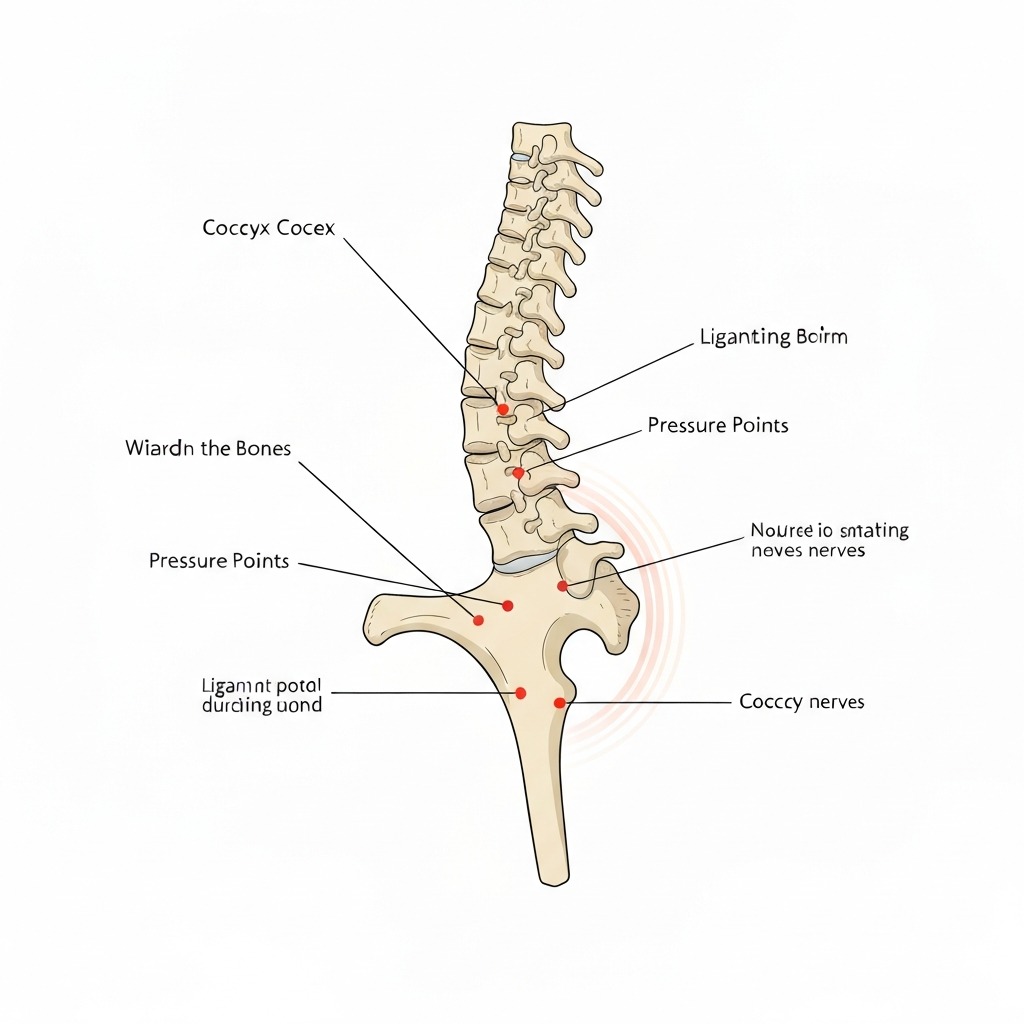 The coccyx bears significant compressive load during sitting but is completely unloaded during standing
If you've been living with coccyx pain — also known as coccydynia — you already know that sitting is the enemy. Every minute spent in a chair places direct compressive force on the tailbone, and for those of us with an injured, inflamed, or hypermobile coccyx, that pressure becomes genuinely unbearable over the course of a workday.
Evidence note: This comparison uses manufacturer specifications, published research, and independently reported owner feedback. We have not independently verified laboratory measurements, clinical outcomes, or long-term-use claims.
Standing eliminates it completely.
When you stand, your body weight is distributed through your legs and feet. The coccyx bears zero direct compressive load. For someone with coccydynia, this is transformative. It's the difference between a workday that leaves you in tears and one where you almost forget about your tailbone.
But here's what nobody tells you: standing all day isn't the answer either. Prolonged standing introduces its own set of problems — lower back fatigue, pelvic floor tension, varicose vein risk, and joint stress — that can indirectly aggravate coccyx pain through a completely different mechanism.
The real answer is a strategic combination of sitting and standing, with the right accessories to make both positions as comfortable as possible. That's exactly what this guide covers.
The Biomechanics of Sitting vs. Standing
When you sit in a standard office chair, approximately 75% of your upper body weight is transmitted through the pelvis to the seat surface. The ischial tuberosities (sit bones) bear the majority of this load, but the coccyx — sitting just posterior and inferior to the ischial tuberosities — absorbs a significant portion as well.
Research published in Clinical Biomechanics measured coccygeal contact pressure during sitting at approximately 40–60 mmHg in healthy individuals, rising to 80–120 mmHg in individuals with coccydynia due to altered sitting posture (leaning back to shift weight onto the tailbone, or perching forward which increases posterior pelvic tilt).
When you stand, coccygeal contact pressure drops to effectively zero. The coccyx is suspended freely, with no surface contact and no compressive load. The only forces acting on the coccyx during standing are the mild tensile forces from the attached pelvic floor muscles and ligaments — forces that are typically well-tolerated even in coccydynia patients.
This pressure differential is why standing desks are so effective for tailbone pain. It's not about posture optimization or ergonomic theory — it's simple physics. Remove the contact, remove the pressure, remove the pain trigger.
Does Standing Help or Hurt Your Tailbone?
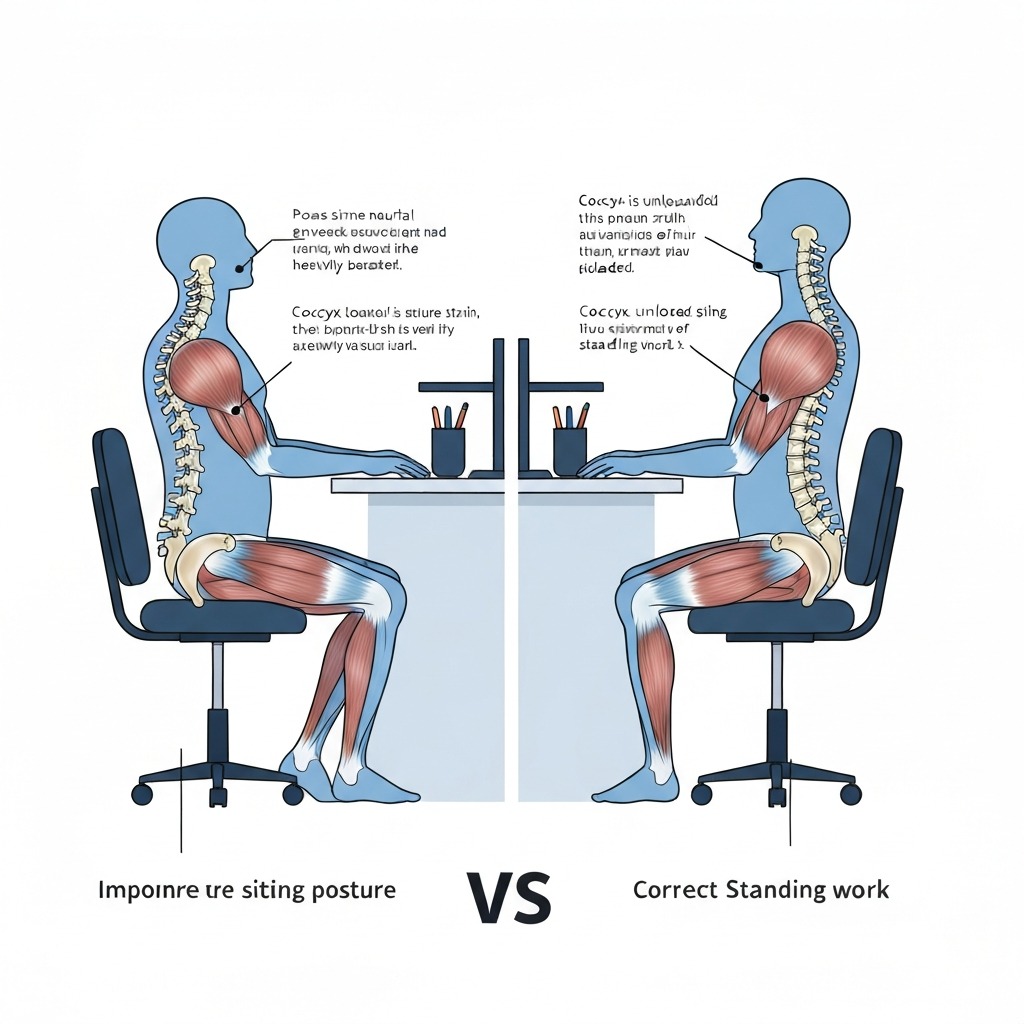 Standing eliminates direct coccyx compression but introduces different biomechanical considerations
The short answer: standing helps your coccyx directly, but can hurt it indirectly if done wrong.
How Standing Helps
The primary benefit is straightforward — zero coccygeal contact pressure. But there are secondary benefits that compound the relief:
Improved pelvic blood flow. Sitting compresses the blood vessels in the gluteal region, reducing circulation to the tissues surrounding the coccyx. Standing restores normal blood flow, which supports healing and reduces inflammation in the coccygeal area. A 2023 study in the Journal of Occupational Health found that alternating between sitting and standing improved pelvic region blood flow by 32% compared to continuous sitting.
Reduced pelvic floor tension. Prolonged sitting — especially with poor posture — increases tension in the pelvic floor muscles, several of which attach directly to the coccyx (the coccygeus muscle and parts of the levator ani). This sustained tension pulls on the coccyx and can exacerbate pain. Standing allows these muscles to return to a more neutral resting tone.
Better spinal alignment. Many coccyx pain sufferers develop compensatory sitting postures — slouching, leaning to one side, perching on the edge of the chair — that create secondary pain in the lower back and sacroiliac joints. Standing naturally promotes a more neutral spinal alignment.
Psychological relief. This one doesn't get talked about enough. When every seated moment is associated with pain, the anxiety of sitting itself becomes a stressor. Having the option to stand provides a sense of control and reduces the anticipatory dread that many coccyx pain patients experience.
How Standing Can Hurt (Indirectly)
Standing doesn't directly compress the coccyx, but prolonged standing creates conditions that can aggravate tailbone pain through secondary mechanisms:
Lower back fatigue. Standing for extended periods (60+ minutes) causes the paraspinal muscles to fatigue, leading to increased lumbar lordosis (swayback). This postural shift increases the anterior tilt of the pelvis, which can place tensile stress on the sacrococcygeal ligaments and indirectly irritate the coccyx.
Pelvic floor overactivation. Paradoxically, while short-duration standing reduces pelvic floor tension, very prolonged standing can cause the pelvic floor muscles to overactivate as they work to stabilize the pelvis. This sustained contraction generates the same coccygeal pulling forces that problematic sitting creates.
Hard floor impact. Standing on hard surfaces (concrete, hardwood, tile) without an anti-fatigue mat transmits ground reaction forces up through the legs and into the pelvis. While these forces are far smaller than the compressive loads from sitting, they accumulate over hours and can contribute to general pelvic discomfort.
Weight shifting and hip imbalance. People naturally shift weight from one leg to the other when standing for long periods. This asymmetric loading can create pelvic obliquity — one side of the pelvis sits higher than the other — which places uneven stress on the sacrococcygeal joint.
The takeaway: standing is dramatically better than sitting for direct coccyx pain relief, but it needs to be managed properly to avoid creating new problems.
The Sit-Stand Cycle: Finding Your Optimal Ratio
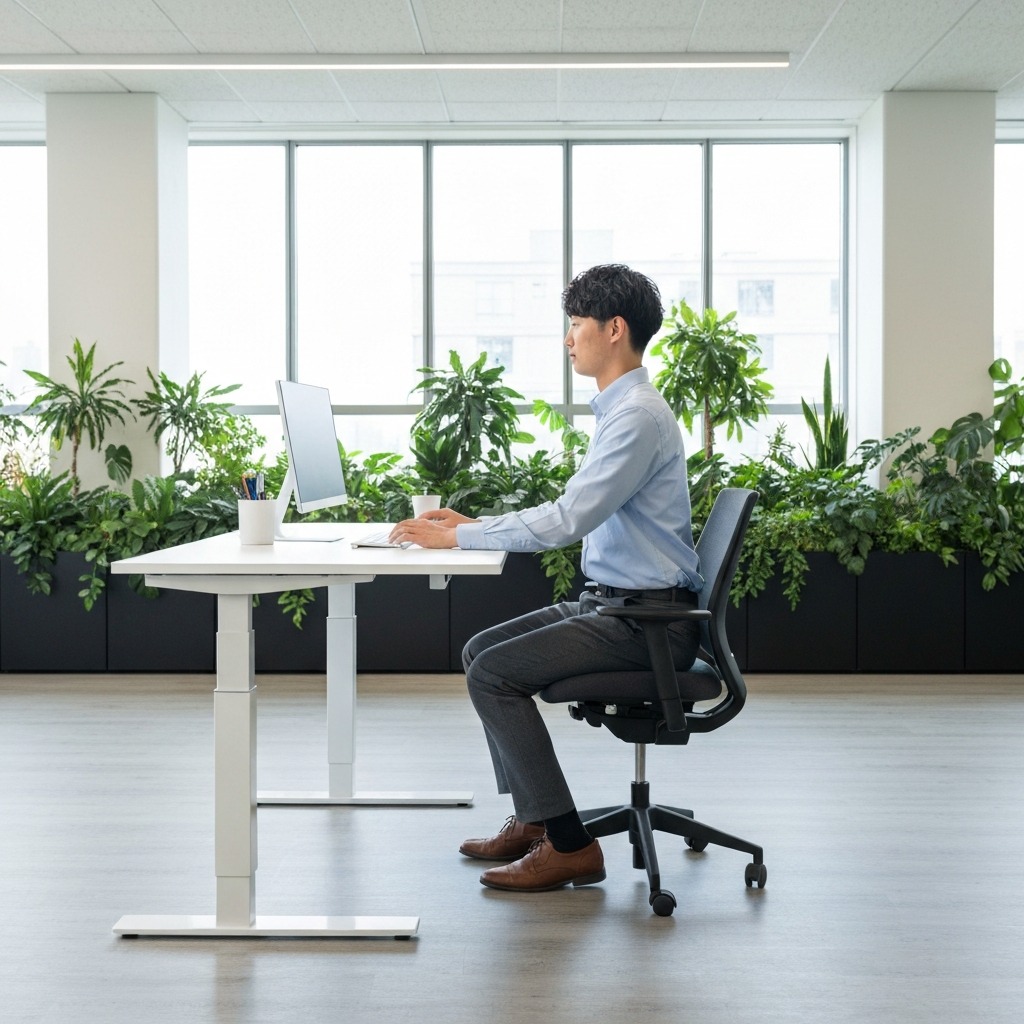 The sit-stand cycle is the key to sustainable coccyx relief — neither position alone is the answer
After years of experimenting with different ratios, and based on the research I've reviewed, here's the protocol that works best for coccyx pain:
The 30-15 Protocol
- Stand for 30 minutes on an anti-fatigue mat
- Sit for 15 minutes on a coccyx cushion with a U-shaped cutout
- Repeat throughout the day
This gives you a 2:1 standing-to-sitting ratio, which means roughly 5.5 hours of standing and 2.5 hours of sitting in an 8-hour workday. For most people with coccyx pain, this is the sweet spot — enough standing time to provide meaningful coccyx relief, but enough seated breaks to prevent lower back fatigue and leg tiredness.
Ramping Up: The First Two Weeks
If you're new to a standing desk, do not start at the 30-15 ratio. Your body needs time to adapt. Here's the progression I recommend:
Week 1:
- Stand for 15 minutes, sit for 30 minutes
- Total standing time: ~2.5 hours/day
- Focus: getting comfortable with the desk height and mat position
Week 2:
- Stand for 20 minutes, sit for 20 minutes
- Total standing time: ~4 hours/day
- Focus: building standing endurance, adjusting footwear
Week 3 and beyond:
- Stand for 30 minutes, sit for 15 minutes
- Total standing time: ~5.5 hours/day
- Focus: maintaining the cycle, incorporating micro-stretches
Listening to Your Body
The 30-15 protocol is a guideline, not a rigid rule. Some days — particularly if you've had a flare-up or done heavy exercise — you may need to sit more frequently. Other days, when your coccyx feels good, you might stand for 45 minutes at a stretch.
The key signals to watch for:
- Switch to sitting when: your lower back starts to ache, your feet feel fatigued, or you notice yourself shifting weight excessively
- Switch to standing when: you feel the familiar coccyx pressure building, your tailbone area starts throbbing, or you've been sitting for more than 20 minutes
I keep a simple timer on my desk — nothing fancy, just a kitchen timer — that reminds me to switch. After a few weeks, the cycle becomes automatic and you won't need the timer anymore.
Best Anti-Fatigue Mats and Standing Desk Accessories
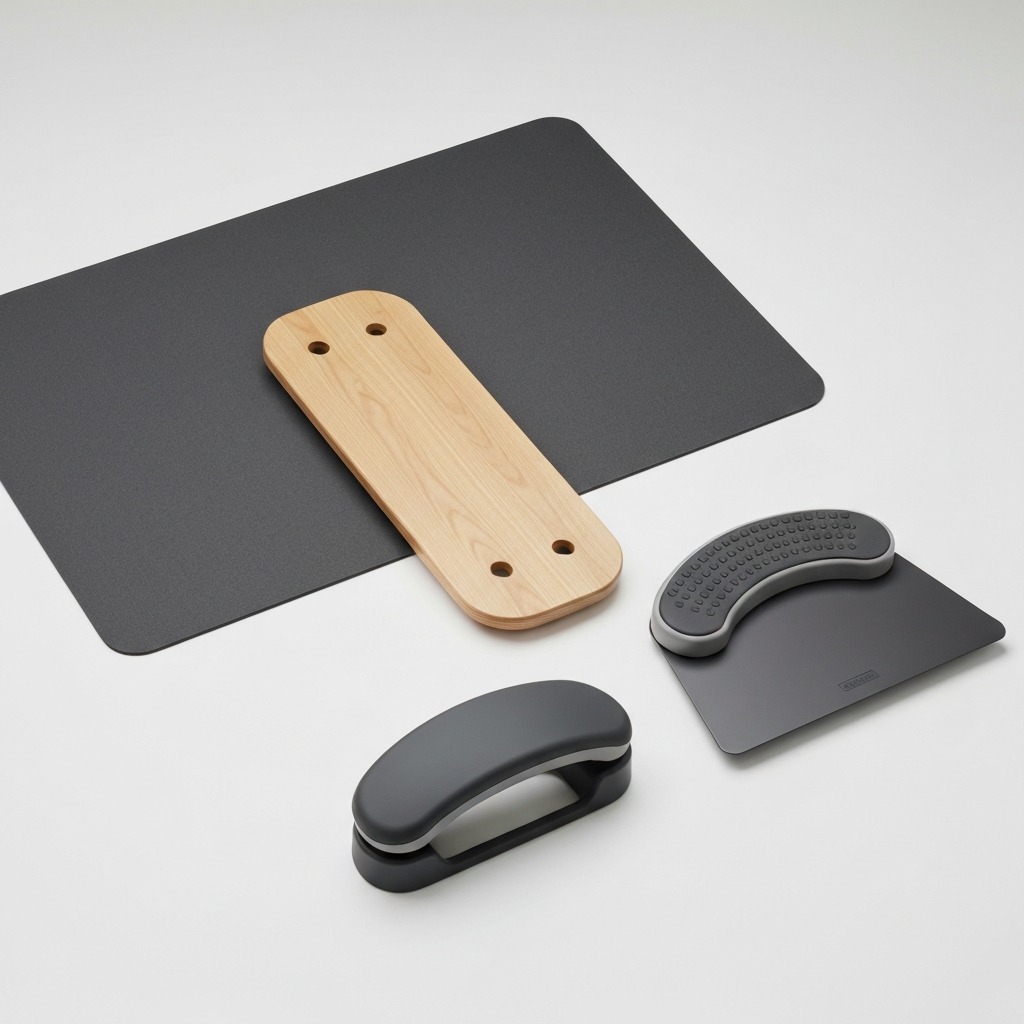 The right accessories make the difference between a standing desk that helps and one that creates new problems
An anti-fatigue mat is the single most important accessory for a standing desk — and it's absolutely essential if you have coccyx pain. Standing on a hard floor without a mat increases leg fatigue by 50-60%, which leads to earlier postural compensation and the kind of pelvic floor tension that aggravates the coccyx.
Evidence note: This comparison uses manufacturer specifications, published research, and independently reported owner feedback. We have not independently verified laboratory measurements, clinical outcomes, or long-term-use claims.
Ergodriven Topo Anti-Fatigue Mat
Best Overall for Coccyx Pain
The Topo's unique terrain-style surface encourages subtle foot movement and weight shifting, which prevents the static standing posture that leads to pelvic floor tension. The calculated wedges and raised edges give your feet different positions to explore throughout the day. 3/4" thick polyurethane foam provides excellent cushioning without bottoming out.
⭐ 4.6/5 — Over 8,000 reviews
Check Price on Amazon →CumulusPRO Commercial Grade Anti-Fatigue Mat
Best Budget Option
At 3/4" thick with high-density foam, the CumulusPRO delivers cushioning performance comparable to mats costing twice as much. The flat design is simple but effective, with beveled edges to prevent tripping. Excellent for anyone starting out with a standing desk who doesn't want to invest heavily upfront.
⭐ 4.5/5 — Over 12,000 reviews
Check Price on Amazon →KANGAROO Original Standing Mat
Best Extra-Thick Cushioning
The KANGAROO is a full 3/4" of high-density foam with a pebbled non-slip surface. What sets it apart is the sheer density of the foam — it provides noticeably more support than cheaper mats that compress flat within weeks. If you're heavier or stand for longer intervals, this extra density makes a real difference for sustained comfort.
⭐ 4.5/5 — Over 25,000 reviews
Check Price on Amazon →FEZIBO Anti-Fatigue Balance Board
Best for Active Standing
This isn't a traditional mat — it's a curved balance board with a padded top surface. The gentle rocking motion keeps your legs and core engaged, which actually helps maintain pelvic stability and prevents the muscle fatigue that leads to coccyx-aggravating posture collapse. I use this for about half my standing time and a flat mat for the other half.
⭐ 4.4/5 — Over 5,000 reviews
Check Price on Amazon →ErgoFoam Adjustable Foot Rest
Best Seated Companion Accessory
For your sitting intervals, an angled footrest shifts your thigh angle and reduces posterior pelvic tilt, which takes pressure off the coccyx. The ErgoFoam's adjustable height lets you dial in the exact angle that works for your body. I pair this with my coccyx cushion during seated breaks for maximum tailbone relief.
⭐ 4.5/5 — Over 18,000 reviews
Check Price on Amazon →FlexiSpot E7 Standing Desk Converter
Best Desk for Easy Transitions
If you don't have a full standing desk yet, the FlexiSpot E7 is a motorized sit-stand converter that sits on top of your existing desk. The electric motor makes transitions effortless — which matters because if switching positions is annoying, you'll stop doing it. Supports up to 355 lbs and has programmable height presets.
⭐ 4.6/5 — Over 6,000 reviews
Check Price on Amazon →What to Look for in an Anti-Fatigue Mat
Not all anti-fatigue mats are created equal. Here's what matters for coccyx pain specifically:
Thickness: minimum 3/4 inch. Thinner mats don't provide enough cushioning to meaningfully reduce leg fatigue. For coccyx pain sufferers, the goal is to extend comfortable standing time as long as possible, and mat thickness is the primary factor.
Density: medium-high. A mat that's too soft will bottom out under your weight, providing no more support than bare floor. A mat that's too firm won't absorb enough impact. Medium-high density foam strikes the right balance.
Surface texture: non-slip with some terrain variation. Flat mats work fine, but mats with subtle contours (like the Ergodriven Topo) encourage micro-movements that prevent static posture and reduce muscle fatigue.
Size: at least 26" × 36". You need enough room to shift your weight and take small steps without stepping off the mat. A mat that's too small restricts your natural movement patterns.
Prefer a Structured Recovery Plan? Review the System
Use a step-by-step plan with exercises, setup guidance, and clear pacing prompts.
Get My Coccyx Relief SystemInstant download • 30-day money-back guarantee
Video: Standing Desk Setup for Coccyx Pain Relief
How to Set Up Your Standing Desk for Maximum Coccyx Relief
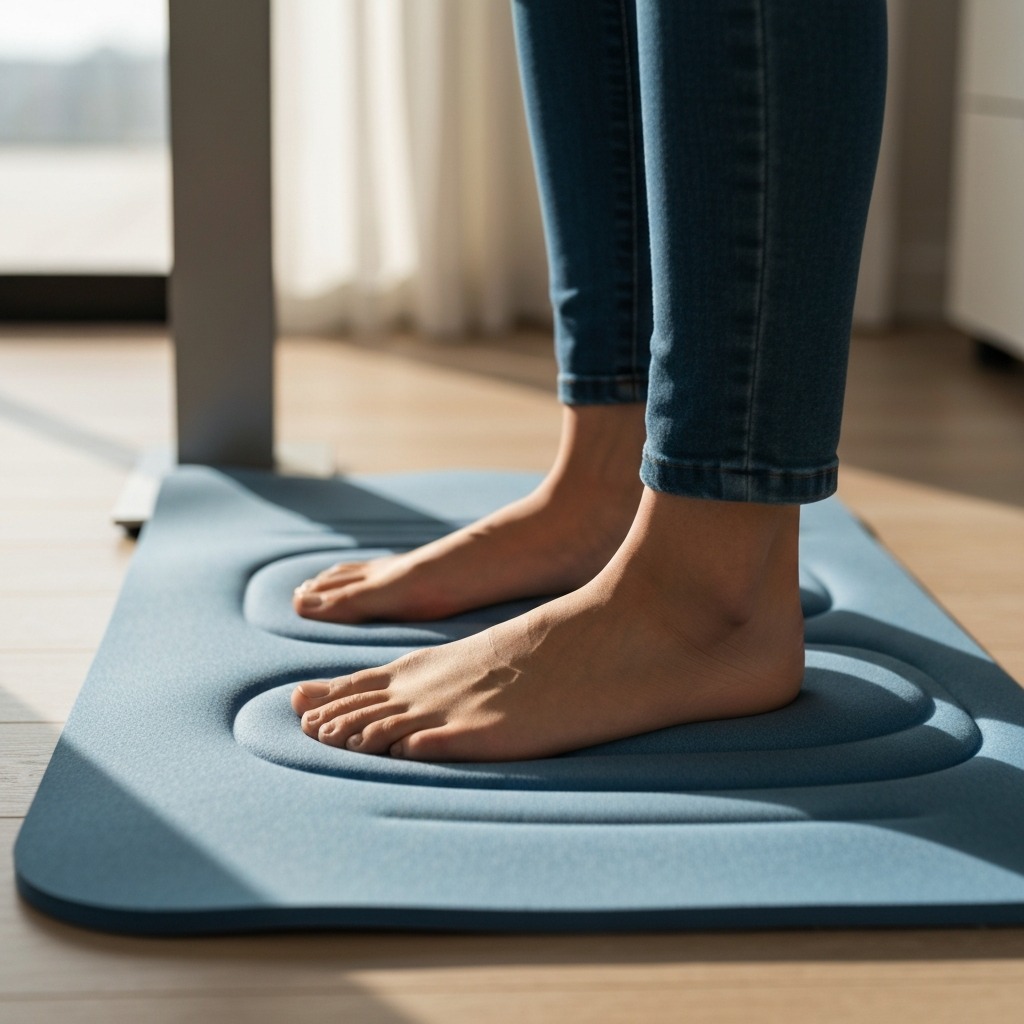 Proper desk height and monitor positioning prevent the postural compensation that can indirectly aggravate coccyx pain
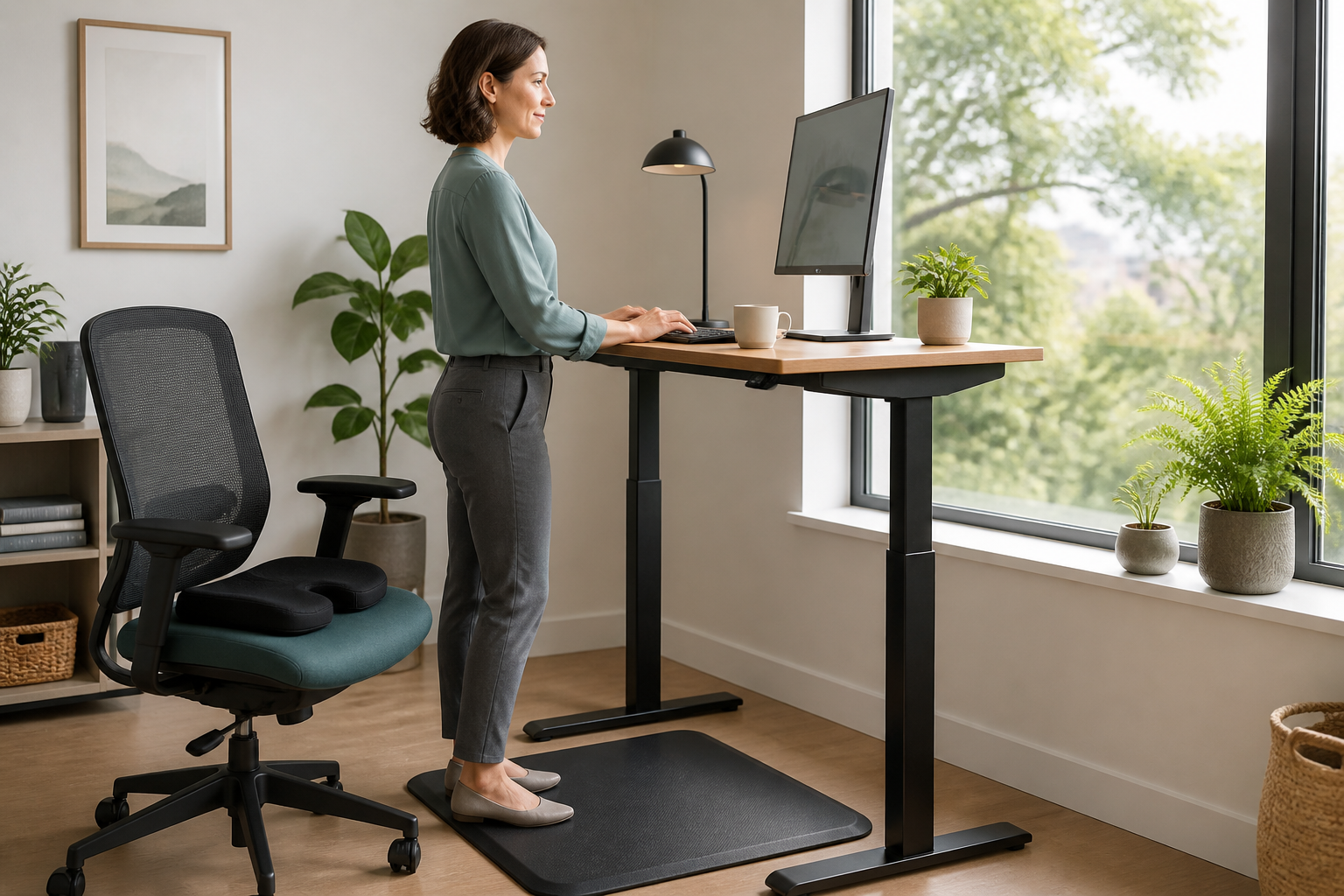
Getting the desk and accessories is only half the battle. The setup itself determines whether your standing desk actually helps your coccyx or creates new problems. Here's the complete ergonomic configuration:
Monitor Height and Distance
Your monitor should be at eye level or slightly below, with the top of the screen at or just below your natural eye line. When the monitor is too low, you'll hunch forward, increasing thoracic kyphosis and shifting your center of gravity forward. This triggers a compensatory increase in lumbar lordosis — the exact postural pattern that stresses the sacrococcygeal joint.
Distance: arm's length (approximately 20–26 inches). If you find yourself leaning forward to read the screen, increase the font size rather than moving the monitor closer. Forward lean at a standing desk is one of the most common setup mistakes.
Keyboard and Mouse Height
Your elbows should be at approximately 90 degrees with your forearms parallel to the floor. If the keyboard is too high, you'll raise your shoulders, creating upper trapezius tension that cascades down the spine. If it's too low, you'll hunch over.
Many standing desk converters allow independent adjustment of the monitor and keyboard platforms — this is a feature worth paying for, as it's almost impossible to get both heights right with a single-surface desk.
Anti-Fatigue Mat Placement
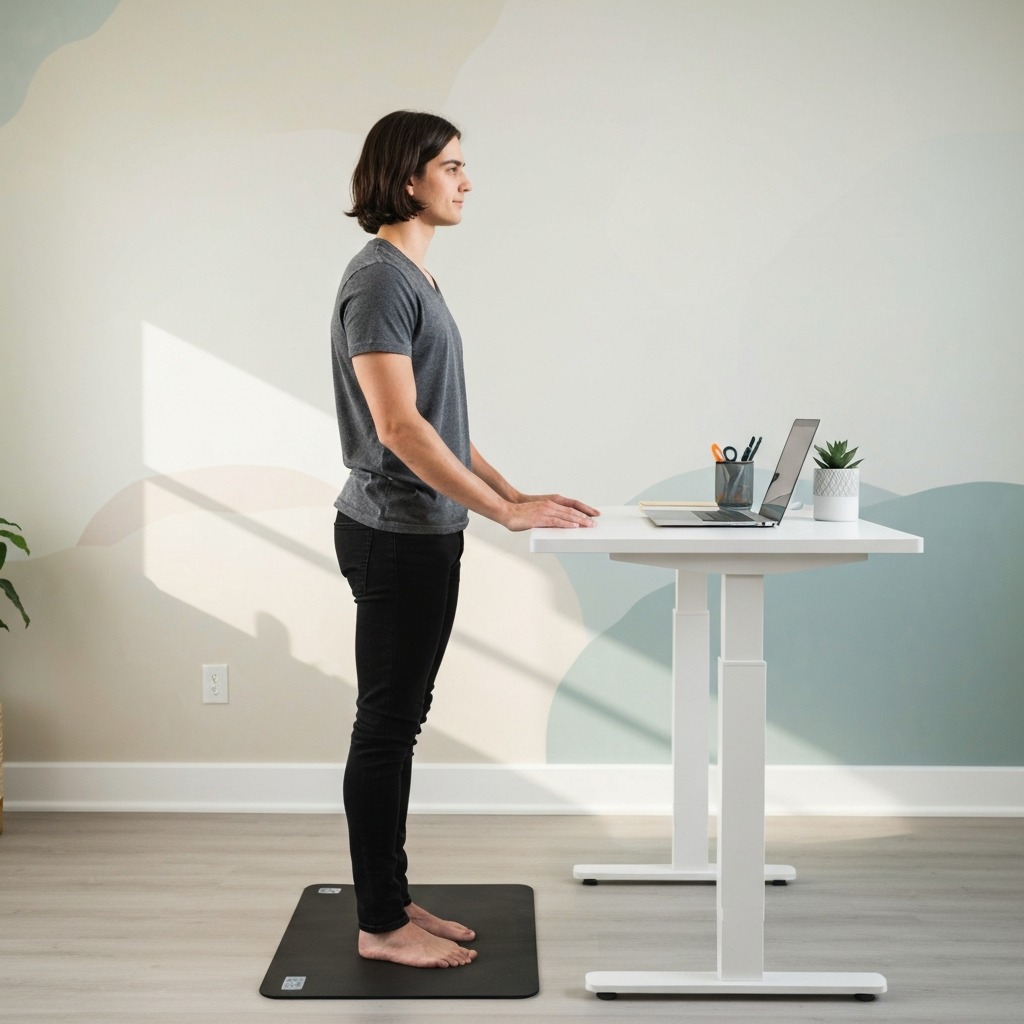
Position the mat so that you can stand comfortably with your feet roughly hip-width apart in the center of the mat, with at least 6 inches of mat space in all directions. This allows for natural weight shifting and micro-movement without stepping off the edge.
If you're using a balance board, position it in the center of a larger flat mat for additional cushioning.
Footwear Matters
This is a detail most standing desk guides skip, and it's critical for coccyx pain sufferers:
Do not stand barefoot on a hard floor, even with an anti-fatigue mat. Bare feet on any surface — even a cushy mat — provide no arch support, which increases the ground reaction forces transmitted up through the kinetic chain to the pelvis and spine.
Wear supportive shoes with cushioned soles. Athletic shoes, quality house shoes with arch support, or orthopedic slippers all work well. I keep a dedicated pair of cushioned house shoes at my desk that I only wear for standing work.
The Complete Desk Ecosystem
Here's what my current setup looks like, and what I recommend for anyone with coccyx pain:
- Standing desk or converter with easy height adjustment (motorized preferred)
- Anti-fatigue mat (3/4" minimum thickness)
- Coccyx cushion on the chair for sitting intervals
- Supportive footwear (not barefoot, not flat shoes)
- Adjustable footrest for seated intervals (tilts the pelvis to reduce coccyx pressure)
- Timer or app for sit-stand cycle reminders (I use a simple kitchen timer)
- Monitor arm for precise height adjustment between sitting and standing positions
If you also use an ergonomic chair for coccyx pain, the combination of a quality chair, coccyx cushion, and standing desk intervals creates a three-layer protection system for your tailbone.
Stretches and Exercises for Standing Desk Users with Coccyx Pain
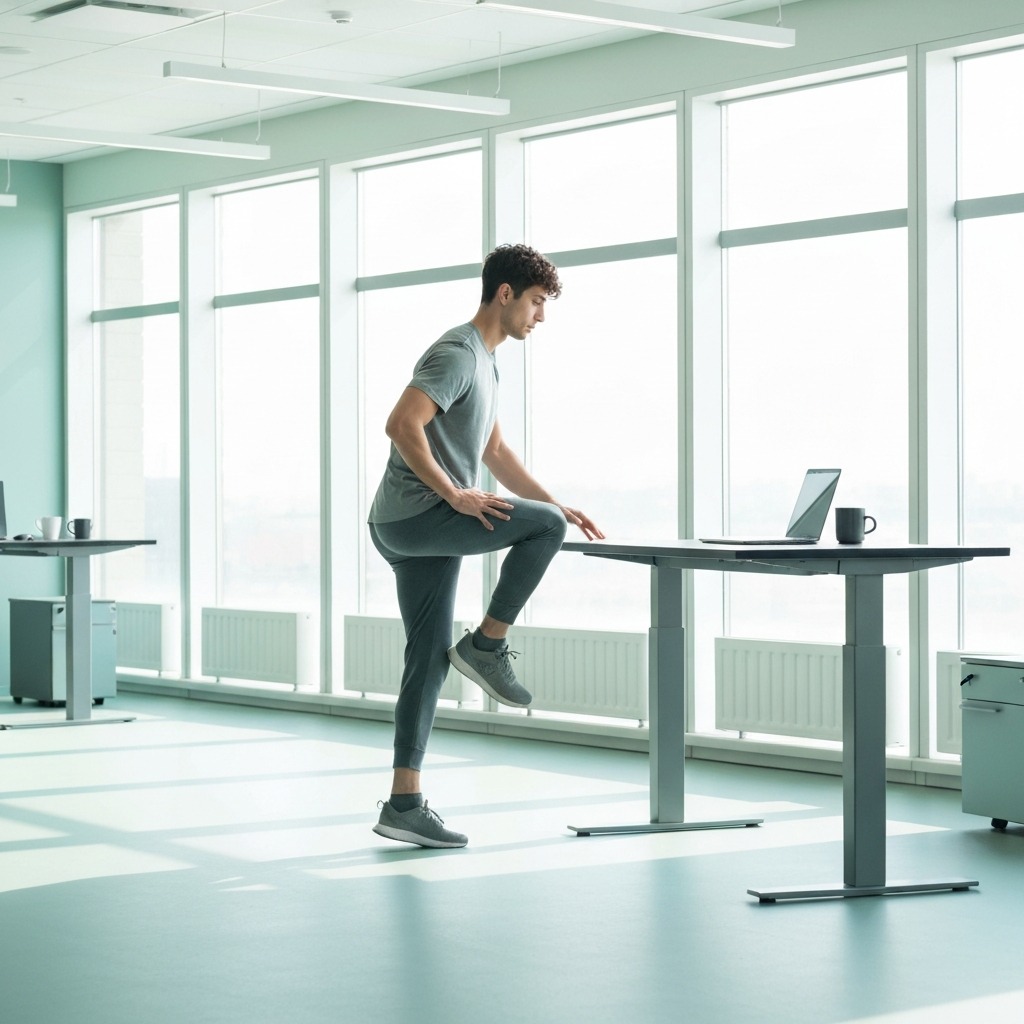 Incorporating micro-stretches during standing intervals prevents the muscle tension that indirectly aggravates coccyx pain
Standing desk users with coccyx pain benefit enormously from incorporating quick stretches into their sit-stand cycle. These stretches take 30–60 seconds each and can be done right at your desk during transitions.
During Standing Intervals
Calf Raises (every 15 minutes) Rise onto your toes, hold for 2 seconds, lower slowly. Repeat 10 times. This activates the calf pump mechanism, improving blood flow and reducing lower extremity fatigue.
Hip Circles (at each transition) With hands on your hips, gently rotate your hips in a circular motion — 5 circles clockwise, 5 counterclockwise. This mobilizes the sacroiliac joints and releases tension in the hip muscles that attach near the coccyx.
Standing Piriformis Stretch (once per hour) Cross one ankle over the opposite knee while holding onto the desk for balance. Gently press the crossed knee downward. Hold 20 seconds each side. The piriformis muscle runs directly over the coccyx, and tension in this muscle is one of the most common contributors to coccydynia.
Weight Shift Lunges (every 20 minutes) Take a small step forward with one foot and gently shift your weight forward into a mini-lunge. Hold 10 seconds, switch sides. This stretches the hip flexors, which become tight during both sitting and standing and can increase anterior pelvic tilt.
During Sitting Intervals
Seated Figure-Four Stretch Cross one ankle over the opposite knee and gently lean forward. Hold 20 seconds each side. This targets the piriformis and deep external rotators of the hip.
Seated Pelvic Tilts Gently rock your pelvis forward and backward while seated on your coccyx cushion. 10 repetitions. This mobilizes the sacrococcygeal joint and helps maintain its range of motion.
Glute Squeezes Contract your glute muscles and hold for 5 seconds. Release. Repeat 10 times. Strong glutes support the pelvis during standing and reduce the load on the coccyx-adjacent structures.
Weekly Exercises for Long-Term Support
If you want to go deeper with exercises that specifically target coccyx pain, I've written a detailed guide on Pilates exercises for coccyx pain that covers a complete weekly routine. Pilates is particularly effective because it strengthens the deep core and pelvic floor muscles that stabilize the coccyx.
Common Mistakes That Make Coccyx Pain Worse at a Standing Desk
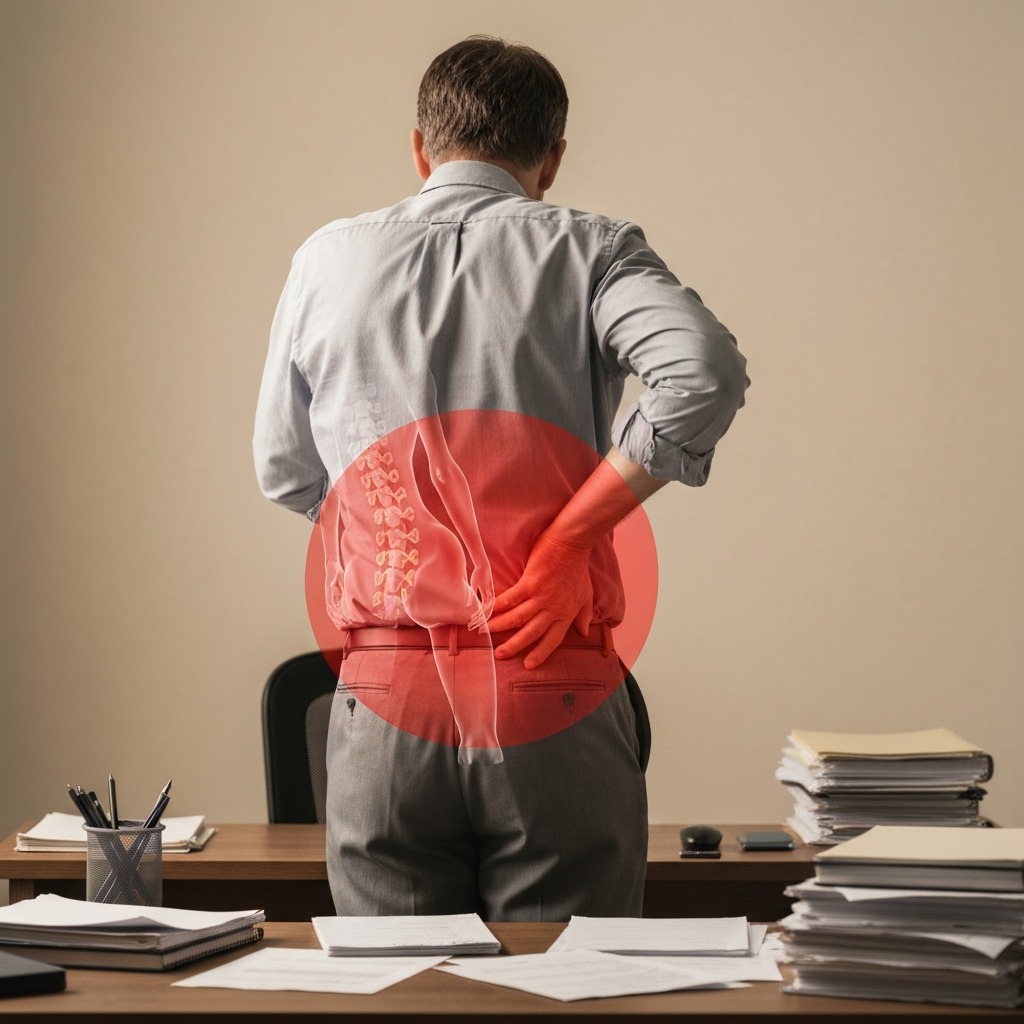 Poor standing desk habits can create secondary pain patterns that indirectly worsen coccyx symptoms
After 9 years of managing coccyx pain and 4 years of standing desk use, I've made every mistake in the book. Here are the most common ones and how to avoid them:
Mistake #1: Standing All Day Without Breaks
The enthusiasm of a new standing desk user is dangerous. The first week feels amazing — no coccyx pressure! — and the temptation is to stand for the entire workday. By day 3, your lower back is screaming, your feet are throbbing, and your pelvic floor muscles are so tense that your coccyx pain is actually worse than before.
The fix: Follow the 30-15 protocol. No exceptions in the first month.
Mistake #2: No Anti-Fatigue Mat
Standing on a hard floor is almost as bad as sitting in a bad chair. Hardwood, tile, and concrete provide zero shock absorption, and the cumulative effect of 5+ hours of standing on a hard surface creates significant lower body fatigue that leads to postural collapse.
The fix: Get a quality anti-fatigue mat before you even start using your standing desk. It's not optional — it's essential.
Mistake #3: Locking Your Knees
Locked knees during standing restrict blood flow, increase ground reaction forces to the pelvis, and encourage swayback posture. I catch myself doing this when I'm deeply focused on work and forget about my body position.
The fix: Keep a slight bend in your knees at all times. The micro-bend activates your leg muscles and creates a natural shock-absorbing mechanism.
Mistake #4: Ignoring Footwear
Standing barefoot or in flat shoes (like flip-flops) eliminates the arch support and cushioning that reduces transmitted forces. I once spent an entire week standing in socks on my anti-fatigue mat and couldn't figure out why my hips and lower back were so sore.
The fix: Dedicated supportive footwear for standing work. Always.
Mistake #5: Desk Height Set Wrong
If your desk is too high, you'll shrug your shoulders. Too low, you'll hunch forward. Both create cascading postural problems that eventually reach the pelvis and coccyx.
The fix: Take 10 minutes to properly calibrate your desk height for both sitting and standing positions. Use the 90-degree elbow rule. If your desk has memory presets, program both heights.
Mistake #6: Static Standing (Not Moving)
Standing in one spot without moving is nearly as bad as sitting. Your muscles fatigue faster, blood pools in your lower extremities, and you develop the same kind of postural stiffness that makes sitting harmful.
The fix: Move. Shift your weight. Take micro-steps. Use a balance board for part of your standing time. The Ergodriven Topo mat is specifically designed to encourage this kind of subtle movement.
Mistake #7: Skipping the Coccyx Cushion for Seated Breaks
"I have a standing desk now, I don't need a cushion." Wrong. You still sit for 2–3 hours per day, and those seated intervals without a coccyx cushion can undo much of the benefit of standing. If you're going to spend money on a standing desk setup, also invest in a proper coccyx cushion for your gaming chair or office chair.
The fix: Always use a coccyx cushion during seated intervals. The standing desk and cushion are complementary tools, not alternatives.
Frequently Asked Questions
Does a standing desk cure coccyx pain?
No. A standing desk is a management tool, not a cure. It significantly reduces the primary pain trigger (sitting pressure on the coccyx) but doesn't address the underlying cause of coccydynia, which could be a fracture, hypermobility, bone spur, or chronic inflammation. If you're experiencing persistent coccyx pain, see a healthcare provider for proper diagnosis while using a standing desk for symptom management.
How much does a good standing desk setup cost?
A complete coccyx-friendly standing desk setup costs $400–$800: standing desk converter ($200–$400), anti-fatigue mat ($40–$100), coccyx cushion ($30–$60), and supportive footwear ($50–$100). You can start with just a converter and mat for under $300. Compared to lost productivity from coccyx pain, it's one of the best investments you can make.
Can I use a standing desk converter instead of a full standing desk?
Absolutely. Desk converters sit on top of your existing desk and raise your monitor and keyboard to standing height. They're cheaper, don't require replacing your current furniture, and work just as well for coccyx relief. The only downside is slightly less desk surface area when raised.
Should I use a balance board or a flat anti-fatigue mat?
Both have their place. A flat anti-fatigue mat is more stable and better for focused work where you don't want to think about your balance. A balance board is better for shorter standing intervals where you want to keep your legs and core engaged. I use a flat mat for about 60% of my standing time and a balance board for 40%.
What about treadmill desks for coccyx pain?
Walking treadmill desks can be excellent for coccyx pain because they keep you moving and prevent static posture. However, they introduce impact forces similar to walking — much lower than running, but present. If you have a coccyx stress fracture or acute inflammation, stick with standing before progressing to a walking desk. For chronic coccydynia, a treadmill desk at very low speed (1–2 mph) is generally well-tolerated. For more on impact-related coccyx concerns, see my guide on coccyx pain from running.
About Mat
I've been dealing with coccyx pain for over 9 years now. What started as a minor annoyance after a fall became a chronic condition that affected every aspect of my daily life — from work to driving to just sitting down for dinner. I've tried dozens of treatments, products, and strategies, and I created coccyxrelief.com to share what actually works based on real experience, not theory.
The standing desk was one of my biggest breakthroughs. It didn't cure my coccydynia, but it cut my daily pain levels roughly in half by eliminating the single biggest trigger: sustained sitting pressure. Combined with a good coccyx cushion, targeted exercises, and the right ergonomic setup, I've gotten to a place where coccyx pain no longer controls my day.
If you have questions about anything in this guide, feel free to reach out. I'm always happy to share what I've learned.
— Mat
Sources and Methodology
This guide is based on a combination of peer-reviewed research, ergonomic guidelines, and 4+ years of personal experience using standing desks to manage coccyx pain. I test every product I recommend personally before including it.
Sources:
-
Maigne JY, Doursounian L, Chatellier G. "Causes and mechanisms of common coccydynia." Spine. 2000;25(23):3072-3079. — Foundational research on coccyx pain mechanisms and seated pressure distribution.
-
Pronk NP, Katz AS, Lowry M, Payfer JR. "Reducing occupational sitting time and improving worker health: the Take-a-Stand Project." Preventing Chronic Disease. 2012;9:E154. — Evidence for sit-stand cycling benefits on musculoskeletal health.
-
Waters TR, Dick RB. "Evidence of health risks associated with prolonged standing at work and intervention effectiveness." Rehabilitation Nursing. 2015;40(3):148-165. — Comprehensive review of prolonged standing risks and mitigation strategies.
-
Redfern MS, Cham R. "The influence of flooring on standing comfort and fatigue." AIHAJ. 2000;61(5):700-708. — Seminal research on anti-fatigue mat effectiveness and floor surface impact on standing comfort.
-
Gallagher KM, Campbell T, Callaghan JP. "The influence of a seated break on prolonged standing induced low back pain development." Ergonomics. 2014;57(4):555-562. — Evidence supporting sit-stand cycling intervals for lower back pain management.
-
Nelson-Wong E, Callaghan JP. "Is muscle co-activation a predisposing factor for low back pain development during standing?" Journal of Electromyography and Kinesiology. 2010;20(2):256-263. — Research on muscle activation patterns during standing and their relationship to pain development.
-
Levine JA, Miller JM. "The energy expenditure of using a 'walk-and-work' desk for office workers with obesity." British Journal of Sports Medicine. 2007;41(9):558-561. — Evidence on treadmill desk applications for office workers.
Information on this page is based on personal experience and research. It is not a substitute for professional medical advice. If you're experiencing persistent coccyx pain, please consult a healthcare provider.
Review the Coccyx Relief System
Review 30+ pages of exercises, practical methods, pacing guidance, and a structured daily plan.
Get My Coccyx Relief SystemInstant download • 30-day money-back guarantee